Airline power bank and battery rules
In the U.S., power banks must go in carry-on bags: up to 100 Wh is allowed, 101–160 Wh needs airline approval and anything over 160 Wh is forbidden. That rules out all but 1 of the 59 current portable power stations we track. Since 2025, 12 of the 15 airlines we checked have also limited using power banks in flight. Below are the federal rules, each airline's policy and the 2026 international changes.
Key findings
Under FAA rules, spare lithium batteries and power banks must go in carry-on bags. Up to 100 Wh is allowed, 101–160 Wh needs airline approval (two spares at most), and anything over 160 Wh is forbidden on passenger planes.
58 of the 59 portable power stations we track are over 160 Wh, so they can't fly in carry-on or checked bags. Only the BLUETTI Elite 10 Mini (128 Wh) falls in the 101–160 Wh band that needs airline approval.
Of the 15 airlines whose own policy pages we could read, 12 restrict using or charging power banks in flight, and 6 ban both. Emirates allows only one power bank per passenger.
International rules tightened in 2026. ICAO limited passengers to two power banks and banned recharging them on board from March 27, 2026, and South Korea and Japan added national limits in April 2026.
U.S. federal rules haven't adopted the new ICAO limits; 49 CFR 175.10 was last amended in 2024. Stricter U.S. rules come from individual airlines, such as American Airlines, Delta Air Lines and JetBlue.
What are the FAA rules for power banks and lithium batteries?
Under U.S. Federal Aviation Administration and TSA rules, power banks and spare lithium-ion batteries must travel in carry-on bags, never in checked luggage. A passenger may bring spare batteries of up to 100 Wh each for personal use with no federal limit on how many. Up to two spares of 101–160 Wh are allowed with the airline's approval, and batteries over 160 Wh are forbidden on passenger aircraft. Batteries installed in devices such as laptops follow similar watt-hour limits, but the device may go in checked bags if it is switched fully off and protected.
| Rule (official source) | Applies to | What it says | Effective |
|---|---|---|---|
| FAA PackSafe - Lithium Batteries | US | Spare Li-ion/Li-metal batteries incl. power banks and charging cases: carry-on only, terminals protected. Li-ion <=100 Wh per battery; with airline approval up to 2 spares 101-160 Wh. No quantity limit for <=100 Wh (personal use). Airlines may be stricter. Damaged/recalled batteries forbidden. | page last updated 2026-08-11 |
| FAA PackSafe - Airline Passengers and Batteries | US | 0-100 Wh allowed; 101-160 Wh requires air-carrier approval; >160 Wh forbidden. No limit under 100 Wh; max 2 spares (incl. power banks) 101-160 Wh. Devices may be checked only if fully powered off. Spares/power banks carry-on only. | page last updated 2026-10-02 |
| FAA PackSafe - Power Station poster (PDF) | US | Do not pack power stations in checked baggage. Devices >160 Wh not allowed on passenger aircraft. Power banks/power stations <=160 Wh must be kept in the cabin (101-160 Wh needs airline approval per FAA tiers). | — |
| FAA PackSafe - Spare lithium batteries packing poster (PDF) | US | 0-100 Wh allowed; 101-160 Wh possible, max 2, check with air carrier for approval; 161+ Wh forbidden in carry-on and checked. | — |
| TSA What Can I Bring - Power Banks | US | Carry-on yes, checked no. | — |
| TSA What Can I Bring - Lithium batteries with 100 watt hours or less in a device | US | Carry-on yes; checked yes (special instructions) for installed batteries; spares carry-on only; Li-ion <=100 Wh, Li-metal <=2 g. | — |
| TSA What Can I Bring - Lithium batteries with more than 100 watt hours | US | Carry-on yes (special instructions), checked no; with airline approval up to two spare 101-160 Wh Li-ion (or 2-8 g Li-metal). | — |
| 49 CFR 175.10(a)(18) (eCFR, current as of 2026-10-20) | US | Spare lithium batteries carry-on only, individually protected, UN 38.3 tested. Li-ion <=100 Wh; with operator approval PEDs may contain 100-160 Wh, and no more than two spares each 100-160 Wh per person in carry-on. Power banks must be carried as spare batteries. PEDs in checked bags must be completely off. No federal count limit at <=100 Wh; no in-flight-use rule. | 2024-05-10 (latest amendment of 175.10) |
| 49 CFR 175.10(a)(18)(iv) | US | Power banks are treated as spare batteries. | 2024-05-10 (latest amendment) |
| ICAO news - New power bank restrictions (Addendum No.1 to Doc 9284, 2025-2026 ed.) | International (ICAO) | Power banks limited to two per passenger; recharging power banks during flight prohibited; crew operational exception. | 2026-03-27 |
| IATA Guidance Document for Operators - Power Banks (31/03/2026) | International (IATA) | Power banks carry-on only; must not be recharged on board (new requirement); should not be used to recharge a PED on board (new recommendation); max two per person (new requirement); individually protected. Addendum allows 100-160 Wh power banks with operator approval but IATA says this will not carry into DGR 68th ed. (effective 2027-01-01). | 2026-03-27 |
| IATA Guidance - Passengers Travelling with Lithium Batteries (31/03/2026) | International (IATA) | Max two Li-ion power banks <=100 Wh; not recharged from aircraft power; not in overhead lockers; not used to power devices during taxi/take-off/landing. Table lists power bank >100-<=160 Wh as Forbidden; max 20 spare batteries / 15 PEDs per person unless operator approves more. | — |
| CAAC (China) - CCC/3C power bank ban | China (domestic flights) | Power banks without CCC (3C) mark, with unclear CCC mark, or from recalled models/batches banned on domestic flights. | 2025-06-28 |
| Korea MOLIT press release (korea.kr, 2026-04-08) | South Korea | Max 2 power banks per person; in-flight use and charging fully banned (both charging the power bank and charging devices from it). | 2026-04-20 |
| Japan MLIT press release (2026-04-14) | Japan | Max 2 mobile batteries in cabin (each <=160 Wh); no charging the mobile battery on board; no charging other devices from it on board. Earlier (from 2025-07-08): no overhead-bin storage. | 2026-04-24 |
Can you take a portable power station on a plane?
Almost never. The FAA's power station guidance says units over 160 Wh are forbidden on passenger aircraft, in carry-on and checked bags alike, and 58 of the 59 current portable power stations in our database are over that limit. Capacities run from 128 Wh to 6,144 Wh, with a median of 1,264 Wh. The exception is the BLUETTI Elite 10 Mini (128 Wh), which falls in the 101–160 Wh band: it may go in carry-on bags only with the airline's approval, and many airlines will want to see the Wh rating printed on the unit. None is 100 Wh or less, the size most airlines accept without approval. Some battery packs are sold at 99 Wh precisely so they can fly, so check the Wh figure on the label rather than the product name. If you need more power at your destination, ship a power station by ground, or buy or rent one there.
What are each airline's power bank rules?
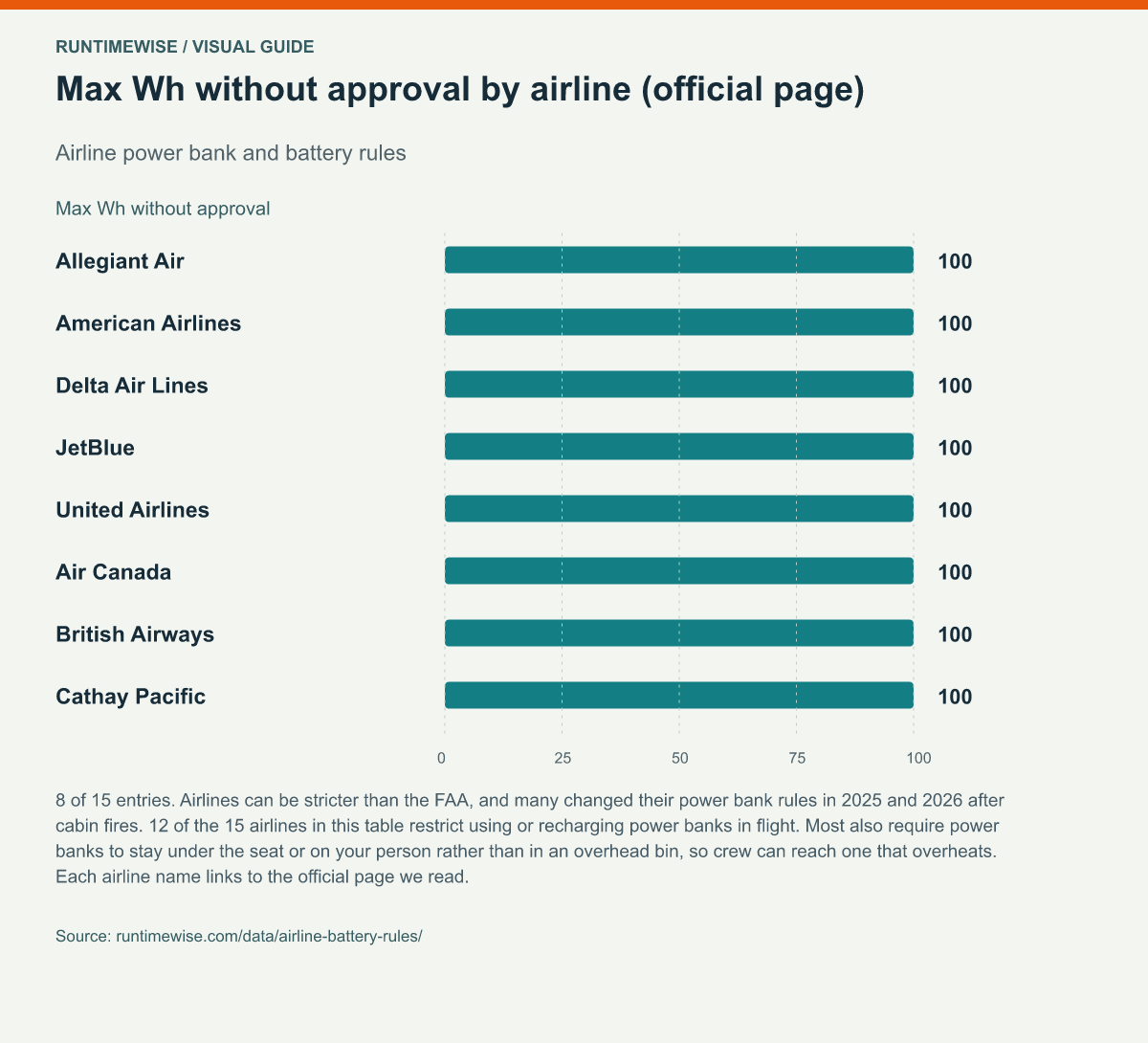
Airlines can be stricter than the FAA, and many changed their power bank rules in 2025 and 2026 after cabin fires. 12 of the 15 airlines in this table restrict using or recharging power banks in flight. Most also require power banks to stay under the seat or on your person rather than in an overhead bin, so crew can reach one that overheats. Each airline name links to the official page we read.
| Airline (official page) | Country | Max Wh without approval | Max power banks | In-flight use limited | What the page says about use on board | Newest rule effective |
|---|---|---|---|---|---|---|
| Allegiant Air | US | 100 | Not stated | No rule stated | Document does not mention power banks by name or in-flight use. Spare lithium batteries carry-on yes, checked no. | 2025-02-20 (PDF creation date; title 'CustomerFacingRestrictedArticles-Update_2025') |
| American Airlines | US | 100 | 2 | Yes | Keep power banks within reach and visible while in use; do not recharge them from seat power onboard; no overhead bins/enclosed spaces. Large power banks / lithium-ion generators (EcoFlow, Jackery, Bluetti, etc.) prohibited in carry-on and checked. | Not stated |
| Delta Air Lines | US | 100 | 2 | Yes | Power banks must not be recharged on board or be used to recharge a PED during taxi, take-off, landing. Stow under seat or seatback pocket, not overhead bin. | Not stated |
| JetBlue | US | 100 | 2 | Yes | Power banks must not be recharged onboard and must not be used to recharge a PED onboard; not charged via in-seat power. Store under seat, not overhead bin. Not in checked bags. | Not stated |
| United Airlines | US | 100 | Not stated | No rule stated | Page silent on in-flight use/charging. Power banks not allowed in checked bags; remove from gate-checked bags. | Not stated |
| Air Canada | CA | 100 | Not stated | No rule stated | No in-flight use/charging rule stated. Bans Anker A1647/A1681/A1689 on board. Overall 20 spare cells/battery packs per passenger. | Not stated |
| British Airways | GB | 100 | 2 | Yes | Seat power only for charging devices, not power banks. Page does not ban using a power bank to charge a device. | Not stated |
| Cathay Pacific | HK | 100 | 2 | Yes | No use or recharging at any time during flight (HK CAD rules). Under seat in front, never overhead. Excess power banks confiscated at HKG. | 2026-03-30 |
| Emirates | AE | 100 | 1 | Yes | No use to charge devices; no charging from aircraft power; capacity rating must be shown; not in overhead bin. | 2025-10-01 |
| Korean Air | KR | 100 | 2 | Yes | Use and charging strictly prohibited; overhead bin storage prohibited. Applies to Hanjin Group carriers (Korean Air, Asiana, Jin Air, Air Busan, Air Seoul). | 2026-01-26 |
| Lufthansa (Lufthansa Group) | DE | 100 | 2 | Yes | Neither use nor charging on board; exception for essential medical devices. | 2026-01-15 |
| Qantas (incl. QantasLink, Jetstar) | AU | 100 | 2 | Yes | No use or charging, including in-seat power/USB. Keep in seat pocket or under seat. MOBIKINS MK-PB-04 banned. | 2025-12-15 |
| Qatar Airways | QA | 100 | 2 | Yes | Charging a power bank banned in all phases. Using one to charge a device allowed in non-critical phases, under direct supervision, not stowed in bag/overhead bin. Power banks count toward 20-spare limit. | Not stated |
| Ryanair | IE | 100 | 2 | Yes | Power banks must not be recharged onboard; may charge devices except during taxi/take-off/landing. On person or under seat, never overhead locker. | Not stated |
| Singapore Airlines | SG | 100 | 2 | Yes | No use or charging throughout the flight, including in-seat power/USB. Not in overhead compartments. | 2026-04-15 |
"Not stated" means the airline's page doesn't address it; FAA rules still apply on U.S. flights.
We could not read the official pages of these airlines, so they are not in the table:
- Southwest Airlines: southwest.com hosts failed DNS on this machine (browser and WebFetch); public-DNS fetch returned empty JS shell; reader proxy 403. Search only showed teaser about power bank updates. Visibility rule not confirmed from official page.
- Alaska Airlines: alaskaair.com returns HTTP 406 / bot-block page to curl, WebFetch and browser; only page title retrieved ('Flying with batteries and electronics restrictions', published 2026-09-30).
- Spirit Airlines: customersupport.spirit.com and www.spirit.com did not resolve even via public DNS on 2026-10-22; contract of carriage PDF returned HTTP 502.
- Frontier Airlines: No official Frontier page found addressing power banks. Bag-options lists lithium batteries as prohibited in checked bags; smart-luggage FAQ (modified 2026-02-20) caps smart-bag batteries at 100 Wh; no power bank count or in-flight rules found.
- Hawaiian Airlines: hawaiianairlines.com (now shared Alaska/Hawaiian platform) returns HTTP 406 to all methods; only page title retrieved.
How did international power bank rules change in 2026?
The International Civil Aviation Organization (ICAO), which sets the dangerous-goods rules most countries follow, added a limit of two power banks per passenger and banned recharging them on board from March 27, 2026. IATA's guidance to airlines also advises against using a power bank to charge devices during flight. Several countries went further: China (domestic flights) (from 2025-06-28), South Korea (from 2026-04-20) and Japan (from 2026-04-24). On flights to or within those countries, their rules apply in addition to your airline's.
How do you work out a power bank's watt-hours?
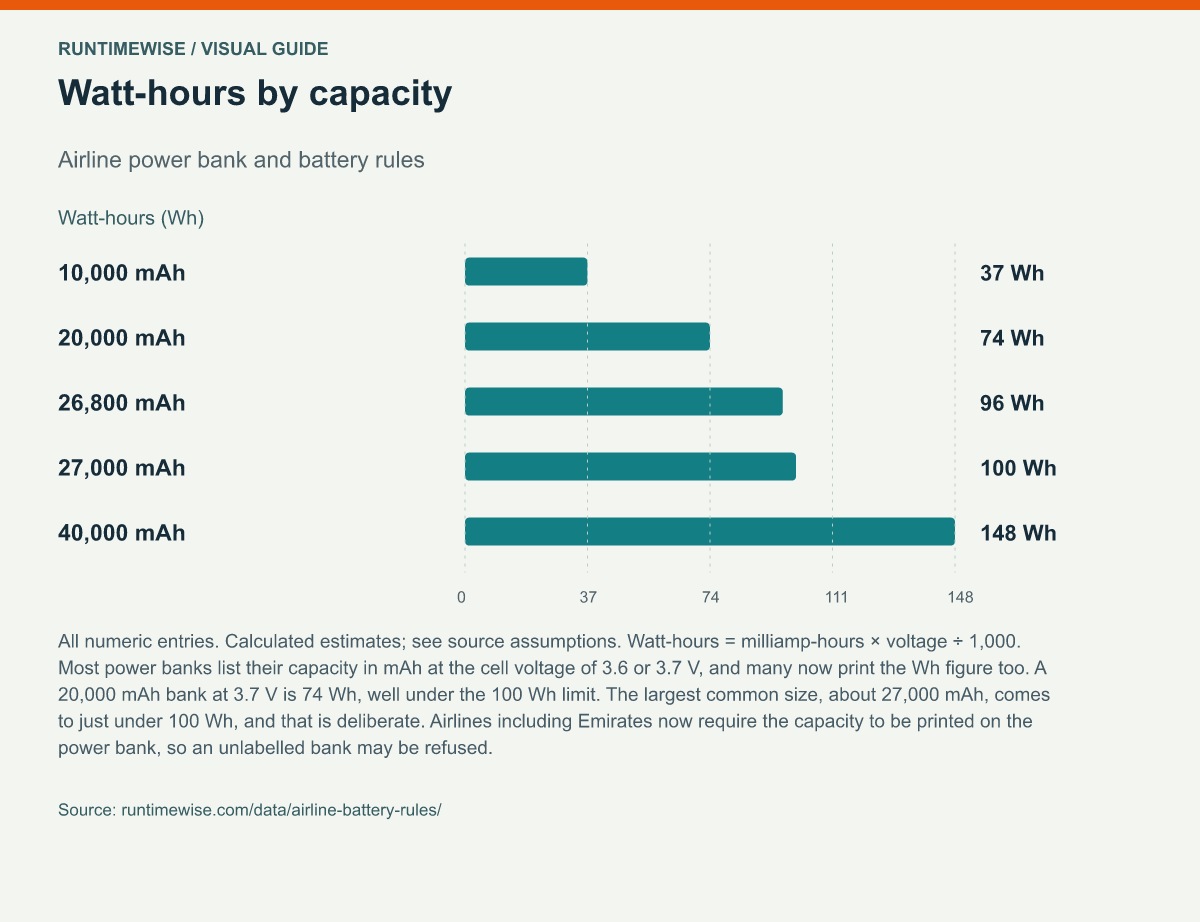
Watt-hours = milliamp-hours × voltage ÷ 1,000. Most power banks list their capacity in mAh at the cell voltage of 3.6 or 3.7 V, and many now print the Wh figure too. A 20,000 mAh bank at 3.7 V is 74 Wh, well under the 100 Wh limit. The largest common size, about 27,000 mAh, comes to just under 100 Wh, and that is deliberate. Airlines including Emirates now require the capacity to be printed on the power bank, so an unlabelled bank may be refused.
| Capacity | Cell voltage | Watt-hours | FAA status |
|---|---|---|---|
| 10,000 mAh | 3.7 V | 37 Wh | Allowed |
| 20,000 mAh | 3.7 V | 74 Wh | Allowed |
| 26,800 mAh | 3.6 V | 96 Wh | Allowed |
| 27,000 mAh | 3.7 V | 100 Wh | Allowed |
| 40,000 mAh | 3.7 V | 148 Wh | Airline approval |
Can you download and reuse this data?
Yes. The main table is available as a CSV file (20 rows), and every chart on this page opens as a full-size image when you select it. Our compilation, calculations and charts are licensed CC BY 4.0: reuse them in articles, reports, slides or lessons, as long as you credit RuntimeWise and link to this page. The underlying data belongs to the sources listed below, so please credit them too.
How should you cite this page?
Copy one of these. A link to this page is the only credit we ask for.
Citation
RuntimeWise (2026). Airline Power Bank and Battery Rules (2026). Retrieved October 22, 2026, from https://www.runtimewise.com/data/airline-battery-rules/HTML link
<a href="https://www.runtimewise.com/data/airline-battery-rules/">Airline Power Bank and Battery Rules (2026)</a> (RuntimeWise)How was this data compiled?
We read each regulator's and airline's own official page on 2026-10-22: FAA PackSafe pages and posters, TSA "What can I bring" entries, the eCFR text of 49 CFR 175.10, ICAO and IATA notices, and the civil aviation authorities of China, South Korea and Japan. Every row links to the page used. Airlines whose official pages couldn't be read are listed separately and left out of the counts.
- "In-flight use limited" means the airline restricts using a power bank to charge devices, or recharging the power bank itself, during some or all of the flight.
- Rules change quickly. Check your airline's page before you fly, especially for international trips, and note that a codeshare flight follows the operating airline's rules.
- Medical devices such as portable oxygen concentrators and CPAPs have separate allowances under 49 CFR 175.10 and U.S. disability rules; ask your airline in advance.
Sources
- FAA PackSafe - Lithium Batteries
- FAA PackSafe - Airline Passengers and Batteries
- FAA PackSafe - Power Station poster (PDF)
- FAA PackSafe - Spare lithium batteries packing poster (PDF)
- TSA What Can I Bring - Power Banks
- TSA What Can I Bring - Lithium batteries with 100 watt hours or less in a device
- TSA What Can I Bring - Lithium batteries with more than 100 watt hours
- 49 CFR 175.10(a)(18) (eCFR, current as of 2026-10-20)
- 49 CFR 175.10(a)(18)(iv)
- ICAO news - New power bank restrictions (Addendum No.1 to Doc 9284, 2025-2026 ed.)
- IATA Guidance Document for Operators - Power Banks (31/03/2026)
- IATA Guidance - Passengers Travelling with Lithium Batteries (31/03/2026)
- CAAC (China) - CCC/3C power bank ban
- Korea MOLIT press release (korea.kr, 2026-04-08)
- Japan MLIT press release (2026-04-14)