Portable power station recalls
The CPSC has announced 5 recalls of portable power stations, covering about 87,270 U.S. units, most for fire or overheating hazards. The latest, in 2026, is the Goal Zero YETI 3000X. Below are every recall with its hazard, incidents and remedy, a link to the official notice, and how to check your own unit.
Key findings
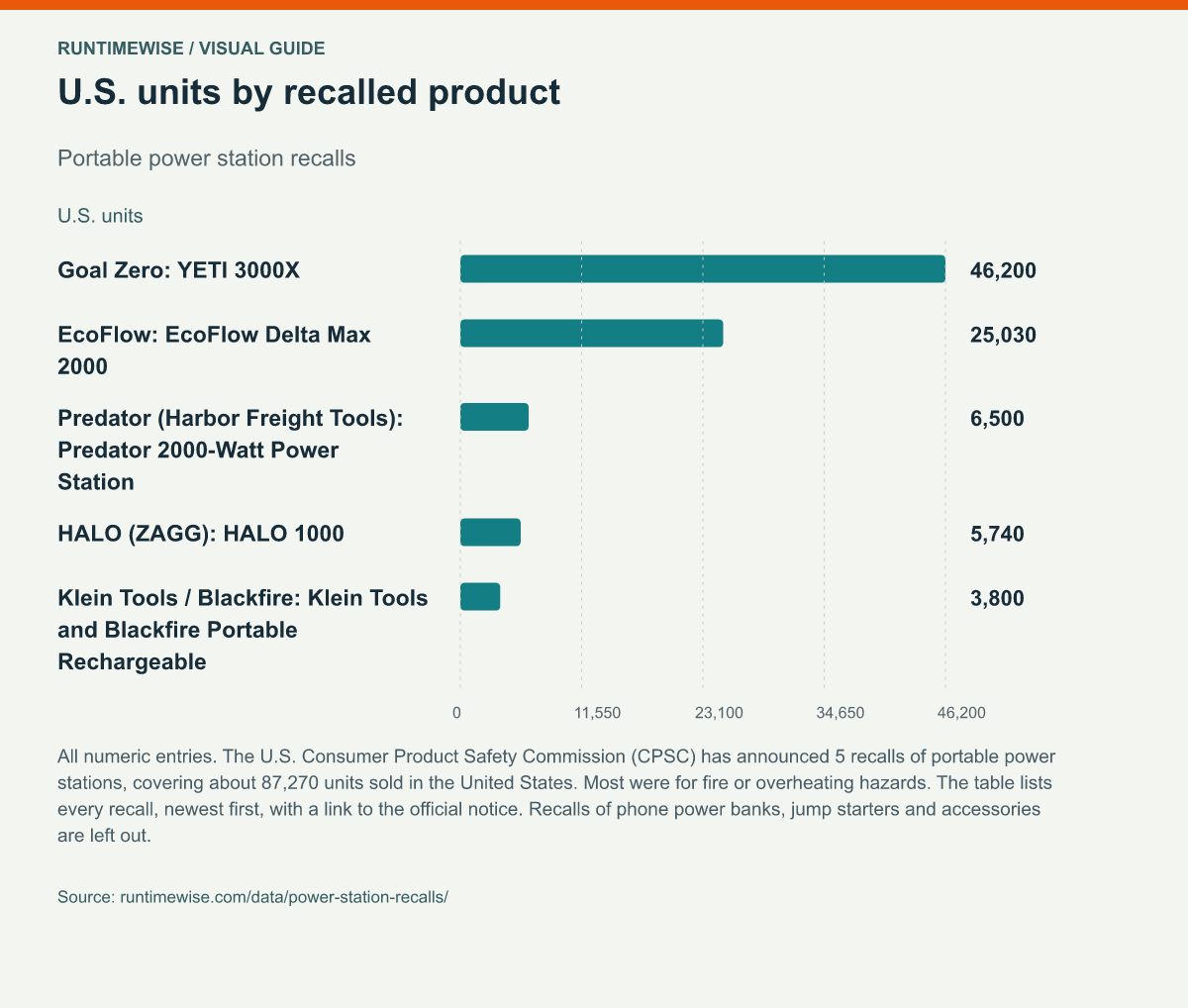
The U.S. Consumer Product Safety Commission has announced 5 recalls of portable power stations, covering about 87,270 units sold in the U.S.
4 of the 5 were for fire or overheating hazards. Firms reported 20 incidents across them, including 1 death.
The largest is the Goal Zero YETI 3000X recall (46,200 units, 2026).
The most recent is the Goal Zero YETI 3000X recall announced on 2026-08-20: circuit board can overheat; fire and burn hazard.
4 of the 5 were announced in 2024 or later. None of the 59 current models in our database is covered by a recall.
Which portable power stations have been recalled?
The U.S. Consumer Product Safety Commission (CPSC) has announced 5 recalls of portable power stations, covering about 87,270 units sold in the United States. Most were for fire or overheating hazards. The table lists every recall, newest first, with a link to the official notice. Recalls of phone power banks, jump starters and accessories are left out.
| Announced | Product (CPSC notice) | U.S. units | Hazard | Incidents | Deaths | Remedy |
|---|---|---|---|---|---|---|
| 2026-08-20 | Goal Zero: YETI 3000X | 46,200 | Circuit board can overheat; fire and burn hazard | 4 | 0 | Repair (free firmware update) |
| 2025-10-09 | EcoFlow: EcoFlow Delta Max 2000 | 25,030 | Can overheat and ignite; burn and fire hazard | 6 | not stated | Repair (free firmware update) |
| 2025-07-03 | Predator (Harbor Freight Tools): Predator 2000-Watt Power Station | 6,500 | AC outlet wiring reversed in EPS mode; shock hazard | 1 | 0 | Replace |
| 2024-08-29 | HALO (ZAGG): HALO 1000 | 5,740 | Lithium-ion batteries can overheat; fire and burn hazard, can lead to death | 5 | 1 | Replace |
| 2023-12-21 | Klein Tools / Blackfire: Klein Tools and Blackfire Portable Rechargeable | 3,800 | Internal inverter boards can overheat; fire and burn hazard | 4 | 0 | Return to place of purchase |
What did each recall say?
The details below are from each CPSC notice. Model numbers and serial ranges are on the notice itself, and owners should check those before acting.
Goal Zero YETI 3000X (2026-08-20)
- Units: About 46,200.
- Hazard: The recalled power station's circuit board can overheat, posing a risk of serious injury from fire and burn hazards.
- Incidents: Goal Zero has received four reports of the power stations catching fire, overheating and smoking. No injuries have been reported.
- Sold: REI stores nationwide and online at Costco.com, Backcountry.com, Goalzero.com and other online retailers from May 2020 through August 2025 for about (price not legible on the CPSC record).
- What to do: Consumers should stop using the power stations immediately and install the free repair in the form of a firmware update available through the Goal Zero application or contact Goal Zero for firmware installation at no cost.
- Recall number: 26-712. CPSC notice
EcoFlow EcoFlow Delta Max 2000 (2025-10-09)
- Units: About 25,030.
- Hazard: The Power Stations may overheat and ignite, posing a risk of serious burn injury and fire hazard.
- Incidents: EcoFlow Technology has received six reports of the recalled Power Stations catching fire, with property damage totaling over $850,000.
- Sold: Costco.com, Amazon.com and Ecoflow.com from July 2022 through May 2025 for about $1,600.
- What to do: Consumers should immediately stop using the recalled Power Stations and contact EcoFlow Technology for instructions on installing a free repair in the form of a firmware update.
- Recall number: 26-010. CPSC notice
Predator (Harbor Freight Tools) Predator 2000-Watt Power Station (2025-07-03)
- Units: About 6,500.
- Hazard: The wires in the power station's AC outlet receptacles are reversed when the product is in Emergency Power Supply ("EPS") mode, posing a shock hazard to consumers operating the power station.
- Incidents: The firm has received one report of the wires being reversed in EPS mode. No injuries have been reported.
- Sold: Harbor Freight Tools stores nationwide from February 2025 through April 2025 for about $950.
- What to do: Consumers should immediately stop using the recalled power stations and return them to their local Harbor Freight Tools store for a free replacement unit that will be available at the store. Harbor Freight Tools is contacting all known purchasers directly.
- Recall number: 25-366. CPSC notice
HALO (ZAGG) HALO 1000 (2024-08-29)
- Units: About 5,740.
- Hazard: The lithium-ion batteries in the HALO 1000 Portable Power Station can overheat, posing fire and burn hazards that can lead to serious injury or death.
- Incidents: A 79-year-old man in Bradenton, Florida died from smoke inhalation from a fire involving the recalled portable power station in his home in June 2022. In addition to the death, the firms have collectively received four reports of fires involving the HALO 1000 Portable Power Station, including two reports of smoke inhalation, one of which included burn injuries.
- Sold: ZAGG, ACG and retailer QVC sold about 5,740 units of the portable power stations from October 2021 through March 2022 for between $1,000 and $1,300.
- What to do: Consumers should immediately stop using the portable power stations and contact the HALO Recall hotline for a free replacement portable power station.
- Recall number: 24-350. CPSC notice
Klein Tools / Blackfire Klein Tools and Blackfire Portable Rechargeable (2023-12-21)
- Units: About 3,800 (In addition, about 164 were sold in Canada) in the U.S., plus 164 in Canada.
- Hazard: The top and bottom of the internal inverter boards of the power stations can overheat, posing fire and burn hazards.
- Incidents: Klein Tools received four reports of overheating. No injuries have been reported. No lithium-ion battery fires have been reported.
- Sold: Industrial distributors and electrical wholesalers nationwide from November 2021 through November 2023 for about $1,300.
- What to do: Consumers should immediately stop using the recalled Blackfire and Klein Tools power stations and return the recalled Blackfire and Klein Tools power stations to their original place of purchase. Klein Tools is contacting all known purchasers directly.
- Recall number: 24-067. CPSC notice
How do you check whether your power station is recalled?
Find the model number on the label on the bottom or back of the unit, then compare it with the models in the CPSC notice; some recalls cover only certain serial numbers. You can search all recalls at CPSC.gov and register your product with the manufacturer, so the maker can contact you directly. Several recent recalls were fixed with a free firmware update installed through the brand's app. Others replaced or refunded the unit. If yours is listed, stop using it and follow the remedy in the notice.
Why do power stations get recalled?
Every recall on this list involves the battery or the electronics that control it. 4 were for fire or overheating, from causes such as a circuit board that can overheat or cells that can short. The others involved electric shock. Lithium iron phosphate (LiFePO4) cells, now used in 57 of the 59 current models we track, are less prone to thermal runaway than the NMC cells many earlier units used, but no chemistry removes the risk. Charge on a hard surface away from flammable materials, keep vents clear and don't leave a damaged unit charging.
Which related recalls are not on the main list?
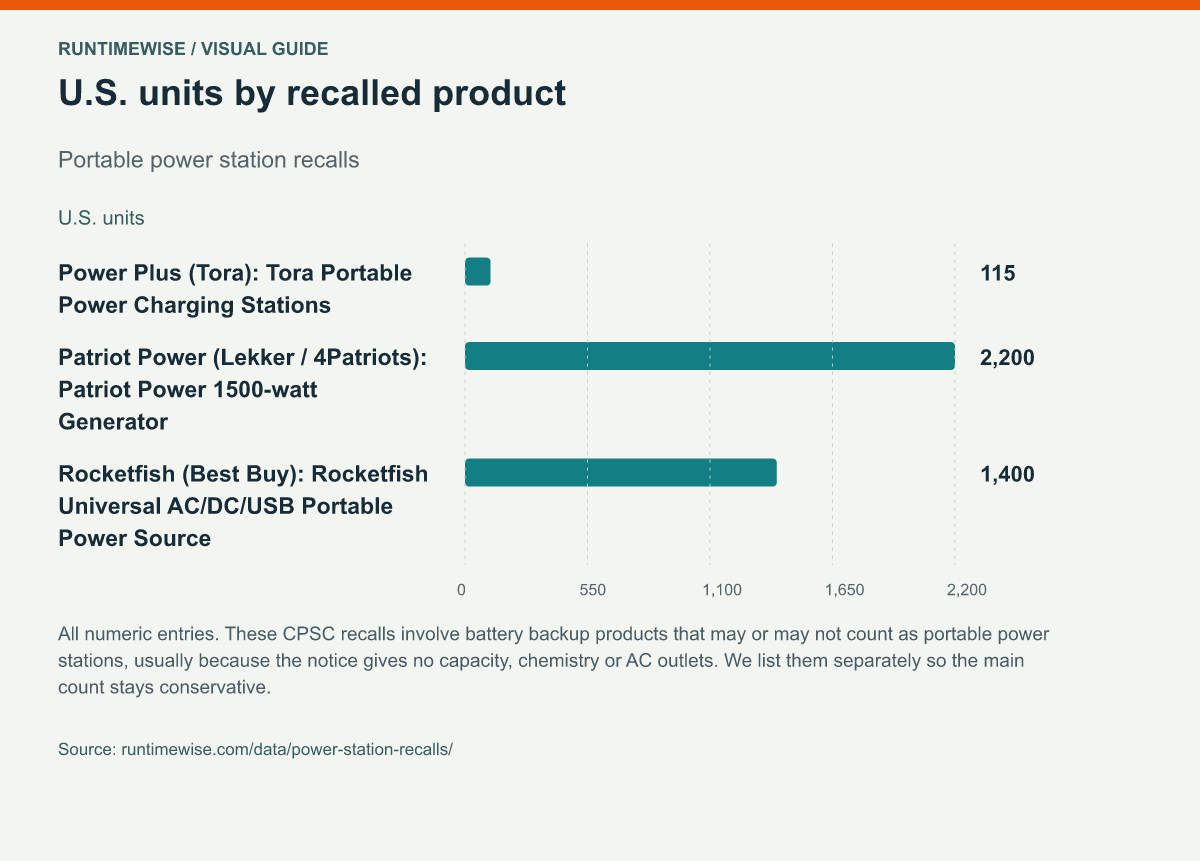
These CPSC recalls involve battery backup products that may or may not count as portable power stations, usually because the notice gives no capacity, chemistry or AC outlets. We list them separately so the main count stays conservative.
| Announced | Product (CPSC notice) | U.S. units | Hazard | Why it is separate |
|---|---|---|---|---|
| 2022-11-03 | Power Plus (Tora): Tora Portable Power Charging Stations | 115 | Lithium-ion battery can catch fire while charging; fire and explosion hazard | Niche product: backup power supply for motorized storm shutters; CPSC record does not state AC outlets or capacity. |
| 2016-07-28 | Patriot Power (Lekker / 4Patriots): Patriot Power 1500-watt Generator | 2,200 | Battery sold with the generator can catch fire | Battery-based 'generator' but CPSC record does not state battery chemistry (may not be lithium), outlets, or 'solar'. Incidents = 13 fires + 2 smoking + 1 noise/odor. |
| 2009-04-02 | Rocketfish (Best Buy): Rocketfish Universal AC/DC/USB Portable Power Source | 1,400 | Can ignite while charging the battery; fire hazard | Small battery AC/DC/USB power source (about $100); chemistry, capacity and outlets not stated. Possibly under 100 Wh. |
Can you download and reuse this data?
Yes. The main table is available as a CSV file (8 rows), and every chart on this page opens as a full-size image when you select it. Our compilation, calculations and charts are licensed CC BY 4.0: reuse them in articles, reports, slides or lessons, as long as you credit RuntimeWise and link to this page. The underlying data belongs to the sources listed below, so please credit them too.
How should you cite this page?
Copy one of these. A link to this page is the only credit we ask for.
Citation
RuntimeWise (2026). Portable Power Station Recalls: Full CPSC List. Retrieved October 22, 2026, from https://www.runtimewise.com/data/power-station-recalls/HTML link
<a href="https://www.runtimewise.com/data/power-station-recalls/">Portable Power Station Recalls: Full CPSC List</a> (RuntimeWise)How was this data compiled?
We searched the CPSC's official recall database (the SaferProducts.gov Recall API) with the terms "power station", "portable power", "solar generator", "power bank", "battery pack" and similar, then read each record. A recall is on the main list when the product is a battery unit with AC outlets sold as a portable power station. Unit counts, hazards, incidents and remedies are copied from the CPSC record, and nothing is estimated. Captured 2026-10-22.
- "Incidents" counts the reports of fires, overheating or shock that firms received, as stated in each notice. Where a notice doesn't state injuries or deaths, we show "not stated" rather than zero.
- Excluded: phone and laptop power banks, jump starters, stationary home batteries, accessories and fuel generators.
- Limits: CPSC recalls are voluntary actions announced with a firm, so a product can have problems without a recall. Recalls by Health Canada or other countries that weren't joint with CPSC aren't listed.
Sources
- CPSC recall database (SaferProducts.gov Recall API)
- CPSC recalls search
- CPSC notice 26-712: Goal Zero YETI 3000X
- CPSC notice 26-010: EcoFlow EcoFlow Delta Max 2000
- CPSC notice 25-366: Predator (Harbor Freight Tools) Predator 2000-Watt Power Station
- CPSC notice 24-350: HALO (ZAGG) HALO 1000
- CPSC notice 24-067: Klein Tools / Blackfire Klein Tools and Blackfire Portable Rechargeable