LiFePO4 vs NMC vs sodium-ion power stations
54 of the 56 current models we track use LiFePO4 (lithium iron phosphate). The older NMC chemistry survives in 1 model and sodium-ion has arrived in 1. With 54 of 56 models on LiFePO4, the chemistry won't separate most pairs of models you compare; their cycle ratings do.
What cycle ratings do current LiFePO4 models carry?
The most common ratings: 4,000 cycles (24 models), 3,000 cycles (12 models), 6,000 cycles (10 models), 3,500 cycles (2 models). A cycle rating is the number of full charge-discharge cycles until capacity drops to a stated level, such as 70% or 80%; brands don't all use the same cut-off, so compare the percentage too.
Which current models don't use LiFePO4?
- Jackery Explorer 300: NMC, rated 800 cycles
- BLUETTI Pioneer Na: sodium-ion, rated 4,000 cycles
How do the three chemistries compare in current models?
| Chemistry | Models | Median rated cycles | Median Wh per lb |
|---|---|---|---|
| LiFePO4 | 54 | 4,000 | 39 |
| NMC | 1 | 800 | 41 |
| Sodium-ion | 1 | 4,000 | 25 |
From current models with AC output; a single NMC or sodium-ion model is not a trend.
What should you compare instead?
- Rated cycles and the capacity percentage they are rated to.
- Warranty length on the brand's own page.
- Watt-hours per pound: current models range from about 22 to 56 Wh per pound, so a higher number means a lighter station for its capacity.
What do official documents say about battery chemistry?
In Sandia National Laboratories' multi-year cell tests, LiFePO4 cells lasted 2,500–9,000 full cycles before falling to 80% capacity, against 200–2,500 for NMC. These were small lab cells, not finished power stations, but the gap matches the cycle ratings brands publish.
Sandia found the two chemistries age in opposite ways between 15 and 35 °C: heat sped up wear for LiFePO4 cells and slowed it for NMC. Keeping a LiFePO4 station out of hot cars and sheds matters more than the cycle rating suggests.
In FAA fire tests, LiFePO4 cells in thermal runaway heated up by an average of 122 °C, against 373 °C for lithium cobalt oxide and 552 °C for lithium manganese nickel cells.
Fire Hazard Analysis for Various Lithium Batteries (DOT/FAA/TC-16/17)
The International Energy Agency says sodium-ion batteries currently store up to 40% less energy for their weight than lithium-ion.
Batteries and Secure Energy Transitions (World Energy Outlook Special Report)
In Sandia's 2026 abuse tests, a commercial sodium-ion cell reached 216.5 °C and vented with sparks when punctured, while an NMC cell reached 98.1 °C with no visible effect. Sandia concluded sodium-ion may not be safer than NMC, despite how it's often marketed.
Sandia's preliminary 2026 data found commercial sodium-ion cells cycled at just 15 °C faded quickly and showed sodium plating, while LiFePO4 and NMC cells under the same conditions held up. Treat cold-weather claims for sodium-ion with caution until more data exists.
What should you read next?
How many years will a power station's cycle rating last?
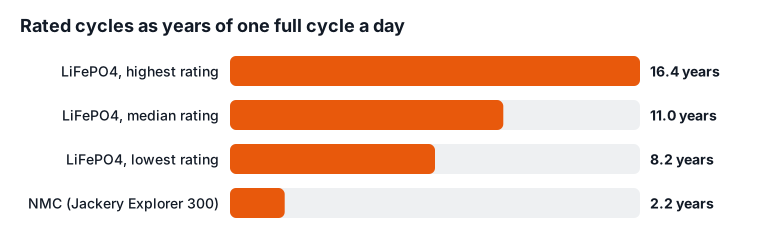
A typical LiFePO4 rating lasts more than a decade even if you drain and refill the station every day. Of the 48 LiFePO4 models that publish a rating, the median of 4,000 cycles works out to about 11.0 years of one full cycle a day. The lowest rating, 3,000 cycles, still gives about 8.2 years. The highest, 6,000 cycles, is about 16.4 years.
If you cycle less often, the rating stretches further. If you run one full cycle every weekend, that is 52 a year, so even a 3,000-cycle rating would take decades to use up. At that pace, the battery's age and how you store it matter more than the cycle count.
A cycle means one full charge's worth of energy. Draining half the battery twice counts as roughly one cycle. Sandia's cell tests found deeper discharges caused more capacity loss in every chemistry, and NMC and NCA cells suffered more than LiFePO4 when moved from partial to full cycles (Degradation of Commercial Lithium-Ion Cells as a Function of Chemistry and Cycling Conditions (Preger et al., J. Electrochem. Soc. 167 120532), Sandia National Laboratories / The Electrochemical Society, 2020). Those were lab cells, but the lesson carries over: avoid running the station to empty when you don't need to.
The NMC exception rates far lower. With Jackery Explorer 300 (NMC, 800 cycles) and BLUETTI Pioneer Na (Sodium-ion, 4,000 cycles) as the outliers, the NMC model's 800 cycles is about 2.2 years of daily use. That suits occasional use and is a poor fit for daily cycling in a van life setup.
What does the percentage in a cycle rating mean?
The percentage is how much of its original capacity the battery still holds when the rated cycles run out. The station keeps working after that point; it just holds less.
Worked example: a 1,000 Wh station rated to 80% should still hold about 800 Wh at the end of its rated cycles. Rated to 70%, it would hold about 700 Wh. At the site's 85% inverter efficiency, 800 Wh gives about 680 Wh at the AC outlets (800 × 0.85), against 595 Wh for the 70% battery (700 × 0.85).
This is why two identical cycle numbers are not equal. A rating of 4,000 cycles to 80% is a stronger promise than 4,000 cycles to 70%. If a brand doesn't state the percentage, treat the rating as hard to compare.
If you size a station for a must-run load, leave room for this fade. A station that only just covers your needs on day one will fall short later.
Why are LiFePO4 power stations heavier, and how much does it matter?
LiFePO4 cells store less energy for their weight than NMC, so a LiFePO4 station weighs more for the same capacity. The International Energy Agency puts LiFePO4 cells at roughly 20–30% lower energy density than high-nickel chemistries such as NMC (Batteries and Secure Energy Transitions (World Energy Outlook Special Report), International Energy Agency, 2024).
In finished stations, the case, inverter and cooling add weight too. Among current models, the lightest for its capacity is the Anker SOLIX S2000 at about 56 Wh per pound. The heaviest is the Goal Zero Yeti 300 at about 22 Wh per pound. The median is 39.
Worked example for a 2,000 Wh station: at 56 Wh per pound it would weigh about 36 lb. At the median of 39 Wh per pound it would weigh about 52 lb. At 22 Wh per pound it would weigh about 92 lb.
Weight per Wh matters most when you carry the station often, as for camping. For a station that sits in a closet for home backup, it matters much less. If you are weighing a lead-acid battery and inverter instead, lithium-ion cells store about 90–300 Wh per kilogram against 35–40 Wh per kilogram for lead-acid (Batteries and Secure Energy Transitions (World Energy Outlook Special Report), International Energy Agency, 2024).
Is LiFePO4 really safer than NMC?
LiFePO4 is the more forgiving chemistry in lab fire tests, but it can still burn. In FAA tests where one cell in a group of five was forced into thermal runaway, no LiFePO4 cell set off its neighbors (Fire Hazard Analysis for Various Lithium Batteries (DOT/FAA/TC-16/17), FAA William J. Hughes Technical Center, U.S. DOT, 2017). The FAA also found that LiFePO4 cells still vent flammable electrolyte. These were small cells in open lab arrays, and a large, enclosed pack can behave differently.
Whatever the chemistry, these habits lower the risk:
- Charge and store the station where you can see it, away from beds, exits and anything flammable.
- Keep it out of hot cars, sun-baked sheds and direct heat.
- Stop using a station that is swollen, cracked, dropped hard or smells of chemicals, and contact the maker.
- Use the charger and cables the maker specifies.
The station's battery management system, cell quality and build matter too, and published specs don't let us judge those. For airline rules on carrying batteries, see our page on small power stations under 500 Wh.
Should you buy a sodium-ion power station now?
Only if you are happy to own a less proven battery. Sodium-ion is promising, but current data shows it is heavier, less proven in the cold and not clearly safer than lithium. The one current sodium-ion model is the BLUETTI Pioneer Na, and the table above shows it is noticeably heavier per watt-hour than the LiFePO4 median.
The case for sodium-ion is mostly about cost and supply. The IEA estimates sodium-ion could be 20–30% cheaper than equivalent LiFePO4 if made at similar scale, while warning it may have a shorter service life (Batteries and Secure Energy Transitions (World Energy Outlook Special Report), International Energy Agency, 2024). That saving depends on lithium prices.
The research is moving fast. PNNL reports sodium-ion energy densities of about 100–200 Wh per kilogram and notes the cells can be shipped fully discharged for safety (Towards Sustainable High-Performance Sodium-Ion Battery Cathodes (DOE OE Peer Review 2023 poster, Lucero et al.), Pacific Northwest National Laboratory, U.S. DOE, 2023). PNNL's own research cells reached about 142 Wh per kilogram and kept 92% of their capacity after 300 cycles (Sodium-Ion Battery Development (DOE OE Energy Storage Peer Review 2026, Presentation ID 702, F. Omenya), Pacific Northwest National Laboratory, U.S. DOE Office of Electricity, 2026). Those are lab prototypes, and 300 cycles is a short test next to LiFePO4 ratings in the thousands.
On safety, Sandia's heat-ramp tests found sodium-ion and NMC cells both vented at 145 °C. Runaway began at 271.1 °C for sodium-ion against 263.7 °C for NMC, but the sodium-ion cell then reached a higher peak, 443.1 °C against 398.1 °C (Multi-Scale Safety and Risk Analysis of Sodium-Ion Batteries (DOE OE Energy Storage Peer Review 2026, ID#705, SAND2026-23907O), Sandia National Laboratories, U.S. DOE Office of Electricity, 2026). These were single small cells, so treat them as an early signal.
If you want a proven battery today, LiFePO4 is the safe choice. Our list of LiFePO4 power stations under $500 is a good place to start.
How should you store a power station between uses?
Store it partly charged, somewhere cool and dry, and top it up on a schedule. Follow the storage charge level and top-up interval in the manual, since makers set these for their own battery and electronics.
- Avoid storing it empty. Every station drains slowly over time. One left empty for months can fall too low to wake up.
- Avoid long storage in heat. Heat speeds up wear on LiFePO4, as the official figures below show. A garage or car in summer is a poor home.
- Turn outputs off. An AC inverter left on drains the battery even with nothing plugged in.
Some stations are built to stay plugged in as a backup supply. If yours is, the manual will say so; see our guide to using a power station as a UPS.
How do you compare two stations' batteries side by side?
Compare lifetime energy, weight per watt-hour and the fine print. 54 of the 56 current models are LiFePO4, so the chemistry label separates few of them.
- Lifetime energy. Multiply capacity by rated cycles. A 1,000 Wh station rated for 4,000 cycles can deliver about 4,000 kWh over its life before fade (1,000 × 4,000 = 4,000,000 Wh). At 800 cycles, the same capacity gives about 800 kWh. This ignores fade, so treat it as an upper bound.
- End-of-life percentage. Check whether the rating runs to 70% or 80%, as covered above.
- Weight per Wh. Divide capacity by weight. Higher is lighter for the energy you get.
- Efficiency. Sandia's cell tests found LiFePO4 cells generally returned more of the energy put into them than NMC or NCA cells, and every chemistry lost efficiency at higher discharge rates (Degradation of Commercial Lithium-Ion Cells as a Function of Chemistry and Cycling Conditions (Preger et al., J. Electrochem. Soc. 167 120532), Sandia National Laboratories / The Electrochemical Society, 2020). That is cell-level data, but it means heavy loads drain a battery a little faster than simple math suggests.
- Temperature ranges. Check the published charging and operating temperatures if you camp in the cold or store the station in a hot space.
Once the battery checks out, pick the capacity you need with our guide to sizing a power station.