How to size a power station
Add up the watts of everything running at once (that must fit the continuous rating), check the biggest start-up surge (that must fit the surge rating), then add up watt-hours per day and divide by about 0.85 for inverter loss. A fridge, router, five LED bulbs and some phone charging for 24 hours needs about 2,834 Wh; 14 of 56 current models hold that much.
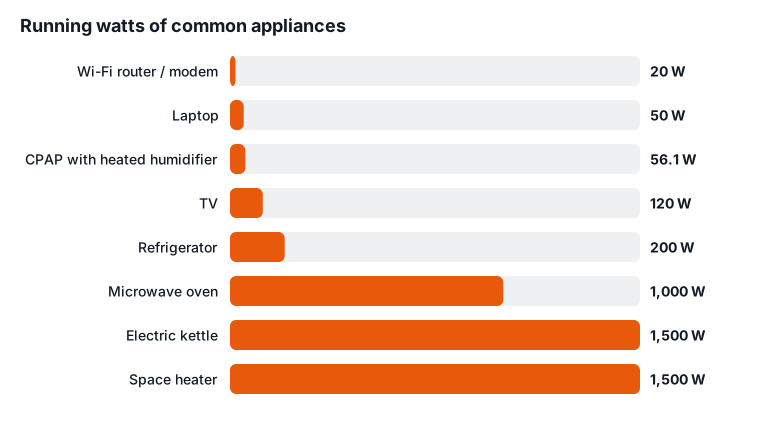
Step 1: how many watts will run at the same time?
List what has to run at the same time and add the running watts from each label. The total must stay under the station's continuous AC rating. A 1,500 W kettle and a 1,000 W microwave together need a station rated for 2,500 W.
Step 2: what is the biggest start-up surge?
Fridges, freezers, pumps and air conditioners draw several times their running watts for a moment when the motor starts. That peak must fit the station's surge rating. See surge vs running watts.
Step 3: how many watt-hours do you need?
Multiply each appliance's watts by the hours it runs. Fridges and freezers cycle, so they run only part of the time. Divide the total by 0.85 to allow for inverter loss.
| Worked example (24 h outage) | Watts | Hours | Wh |
|---|---|---|---|
| Full-size fridge (0.33 duty cycle) | 200 | 24 × 0.33 | 1,584 |
| Wi-Fi router / modem | 20 | 24 | 480 |
| Five 9 W LED bulbs | 45 | 5 | 225 |
| Four phones charging | 40 | 3 | 120 |
| Total ÷ 0.85 | 2,834 |
Wattages: fridge, router. Your own appliances may differ; use their labels.
What do official documents say about real appliance draw?
Panasonic rates its 1,100 W microwave at 1,500 W of power draw. The advertised wattage is cooking power, so size a station by the input figure on the label, which is often about a third higher.
Across 1,179 ENERGY STAR certified laptops, the median idle draw is 4.9 W while the median charger is rated 65 W. The charger rating is the most a laptop can pull while charging under load, not what it uses for light work.
Sandia's inverter model estimates an inverter's own running draw at about 1% of its rated power; one measured 2,500 W inverter used 19.6 W just to stay on. With a small load such as a router, that overhead can cut runtime well below the simple estimate, so turn the AC outlets off when you only need USB or 12 V.
Performance Model for Grid-Connected Photovoltaic Inverters (SAND2007-5036, King et al.)
What should you read next?
How many watts do common appliances use?
Most small electronics use tens of watts, while anything that heats or cooks uses a thousand or more. These are the figures this site uses for its runtime math:
| Appliance | Running W | Start-up W | Duty cycle |
|---|---|---|---|
| Wi-Fi router / modem | 20 | — | 1 |
| Laptop | 50 | — | 1 |
| Phone charger | 10 | — | 1 |
| LED light bulb (60 W-equivalent, 800 lumens) | 9 | — | 1 |
| TV (LED/LCD flat screen) | 120 | — | 1 |
| CPAP with heated humidifier (ResMed AirSense 11) | 56 | — | 1 |
| Refrigerator (full-size) | 200 | 2,200 | 0.33 |
| Chest freezer (~7 cu ft) | 170 | 2,200 | 0.19 |
| Starlink Standard kit | 100 | — | 1 |
| Microwave oven | 1,000 | — | 1 |
| Electric kettle | 1,500 | — | 1 |
| Coffee maker (drip) | 1,200 | — | 1 |
| Space heater (portable electric) | 1,500 | — | 1 |
| Window air conditioner | 720 | 2,800 | 1 |
| Sump pump | 800 | 2,100 | 1 |
| Well pump | 1,000 | 2,100 | 1 |
Running watts count against the continuous rating, start-up watts against the surge rating, and the duty cycle sets how much of the time the appliance draws power. The median current model is rated for 2,000 W continuous, so a kettle and a coffee maker together already go over it. Motor loads like fridges and pumps are covered in the surge vs running watts guide.
Treat these as typical values and check your own labels. Comcast's energy disclosure lists its XB10 modem-router at 29 W and the XB8 at 18 W, so a provider gateway can sit well above the router figure in the table (Comcast SNE Energy Information (CableLabs Energy Reporting), Comcast / CableLabs, 2026).
How do I read an appliance label that only lists amps?
Multiply the volts by the amps. A label that says 120 V and 2 A works out to 240 W. US outlets run at about 120 V, so if a label lists only amps, multiply by 120.
Labels that list both let you check the math. Frigidaire rates its 8,000 BTU window air conditioner at 670 W and 5.9 A when cooling on 115 V (Frigidaire 8,000 BTU Window Room Air Conditioner with Wi-Fi - Product Specifications (FHWW083WBE / FHWW084WD1), Frigidaire, 2023). That is 115 × 5.9, or about 679 W, within a few watts of the rating.
For some electronics, volts × amps overstates the draw. ResMed lists the AirSense 11 at a typical 56.1 W, which it also gives as 111.5 VA (AirSense 11 User Guide (398181, ANZ English/multi), ResMed Ltd, 2023). VA is volts times amps, and here it is about twice the watts. An amps-only estimate leans high, which is the safe direction. If the label gives watts, use the watts.
Two traps: a laptop or CPAP power brick lists the most it can deliver, not what the device draws (ENERGY STAR's median notebook idles at 4.9 W on a 65 W adapter (ENERGY STAR Certified Computers V9.0 (dataset), ENERGY STAR, 2026)), and a microwave's advertised wattage is cooking power, not input. The microwave note further down shows the gap.
What is a duty cycle and why does it matter?
A duty cycle is the share of time an appliance actually runs. A fridge compressor switches on, cools, then rests. If it runs a third of the time, it uses a third of the energy its running watts suggest.
The table's full-size fridge runs at 200 W with a duty cycle of 0.33, which averages 200 × 0.33, or about 66 W. Compare that with ENERGY STAR's database: the median certified fridge averages about 41 W for a top-freezer, 63 W for a bottom-freezer and 73 W for a side-by-side, rated in a lab with the door shut (ENERGY STAR Certified Residential Refrigerators (dataset), ENERGY STAR, 2026).
A hot room or a fridge full of warm food raises the duty cycle. And it lowers energy, not watts: each time the compressor starts, it still needs its full running watts and its start-up spike.
How big a power station do I need for a weekend of camping?
A two-night trip with a 12 V fridge, phones, two lights and a laptop needs about 1,213 Wh:
| Load | Watts | Hours × duty | Wh |
|---|---|---|---|
| 12V compressor fridge | 48 | 48 × 0.22 | 507 |
| Phones | 30 | 6 | 180 |
| Two LED bulbs, 4 h a night | 18 | 8 | 144 |
| Laptop | 50 | 4 | 200 |
| Total ÷ 0.85 | 146 | 48 h | 1,213 |
28 of the 56 current models hold that on their own; the smallest is the Jackery Explorer 1000 Plus at 1,264 Wh. The loads total only 146 W at once, so capacity is the limit here, not the inverter.
Run the 12 V fridge from the car-style DC socket and the phones and laptop from USB. The battery stores DC, so these ports skip the inverter and its conversion loss, and you get more than the 0.85 AC figure suggests. For longer trips, add panels rather than a bigger battery; see solar charging a power station and our camping picks.
What size power station runs a CPAP for two nights?
A CPAP with a heated humidifier needs about 1,056 Wh for two eight-hour nights:
| Load | Watts | Hours × duty | Wh |
|---|---|---|---|
| CPAP with heated humidifier, 2 nights | 56 | 16 | 898 |
| Total ÷ 0.85 | 56 | 2 nights | 1,056 |
31 current models hold that, and the smallest is the Anker SOLIX C1000 at 1,056 Wh. 20 expandable models can go further with add-on batteries.
The table uses ResMed's typical figure, and its rated peak of 73.2 W is higher, so a cold night can use more. The humidifier is the big variable. In ResMed's metered test of the older AirSense 10, the machine used about 7 W alone, 22 W with the humidifier and 34 W with a heated tube too (Power consumption of Air10 devices (ResMed document 1018673/1), ResMed Ltd, 2015). Ask your doctor before changing settings, and ask the CPAP maker before using any power source other than its own supply. See CPAP power use for per-model runtimes.
How big a power station do I need for a 24-hour outage at home?
A fridge, a chest freezer, the internet, lights, a TV and a short microwave session for one day need about 4,611 Wh:
| Load | Watts | Hours × duty | Wh |
|---|---|---|---|
| Full-size fridge | 200 | 24 × 0.33 | 1,584 |
| Chest freezer | 170 | 24 × 0.19 | 775 |
| Wi-Fi router / modem | 20 | 24 | 480 |
| Six LED bulbs, 5 h | 54 | 5 | 270 |
| TV, 4 h | 120 | 4 | 480 |
| Microwave, 20 min | 1,000 | 0.33 | 330 |
| Total ÷ 0.85 | 1,564 | 24 h | 4,611 |
Only 1 current model holds that alone: the Jackery Explorer 5000 Plus at 5,040 Wh. 18 expandable models reach it with add-on batteries at their published maximum, so add-on batteries are the other route to whole-day backup.
With everything on, the loads total 1,564 W. If the freezer starts while all of that runs, the station briefly needs about 3,594 W of surge. Skip the microwave while a compressor is starting and that peak drops.
You can also trim the energy. FEMA says a closed fridge keeps food cold for about four hours and a full freezer for about 48 (Power Outages, FEMA / Ready.gov, 2026). Running the freezer a few hours, then switching it off, cuts its share sharply. See power stations for home backup.
Why should I add headroom beyond my calculated total?
Because the calculation is a best case. Your appliances may run longer than the table assumes, batteries lose usable capacity as they age, cold weather cuts output, and the inverter's own draw (see the note below) eats into small loads. A station working near its continuous rating also runs hotter. Leave room in both numbers: watts for everything you might switch on together, and watt-hours beyond your total.
What do power stations of each size cost and weigh?
Price and weight climb with capacity, but not evenly. Medians across the 56 current models:
| Size band | Models | Median list $ | Median weight (lb) |
|---|---|---|---|
| Under 500 Wh | 9 | 289 | 9 |
| 500–999 Wh | 6 | 614 | 19 |
| 1,000–1,999 Wh | 17 | 674 | 28 |
| 2,000–2,999 Wh | 10 | 1,249 | 47 |
| 3,000 Wh and up | 14 | 2,149 | 89 |
Read the table band by band: where the median price barely rises between two neighbouring bands, the bigger band gives you more capacity for little extra money. Price and weight climb steeply toward the top band, and the largest stations are something you wheel, not carry. Compare 1,000–1,999 Wh models or 3,000 Wh and up.
How do I choose between two sizes?
Pick the smaller one only if it covers your need with room to spare and you will carry it often. Otherwise, take the larger one.
- Multiply capacity by 0.85. A 1,000 Wh station gives about 850 Wh at the AC outlets. If your total is close to that, it is too small.
- Check both power ratings. A bigger battery doesn't always mean a bigger inverter. Make sure the model can run and start your largest load.
- Weigh portability. If it goes in the car every weekend, the band table shows what each step up adds.
- Consider expansion. A station that takes add-on batteries lets you buy smaller now and grow later.
- Count on recharging. Daily solar or car charging lets a smaller battery go further.
The usual mistake is mixing up watts and watt-hours. Watts decide which inverter you need; watt-hours decide how long it lasts. Run your list through the power station runtime calculator to check both.