Surge watts vs running watts
Running watts are what an appliance draws once it is going; surge watts are the short spike when a motor or compressor starts. Most current power stations rate surge at about 2× their continuous output, and 6 of 56 don't publish a surge figure at all.
Which appliances have a big start-up surge?
| Appliance | Running W | Start-up W |
|---|---|---|
| Air compressor (1 hp) | 1,500 | 4,500 |
| Window air conditioner | 720 | 2,800 |
| Electric chainsaw | 1,200 | 2,400 |
| Electric pressure washer | 1,200 | 2,400 |
| Washing machine (clothes washer) | 1,150 | 2,300 |
| Circular saw | 1,400 | 2,300 |
| Refrigerator (full-size) | 200 | 2,200 |
| Chest freezer (~7 cu ft) | 170 | 2,200 |
| Sump pump | 800 | 2,100 |
| Well pump | 1,000 | 2,100 |
From generator-maker wattage guides and manufacturer data; each appliance page links its source.
What should you check before starting a motor load?
- The biggest start-up surge, plus everything else already running, must fit the station's surge rating.
- If no surge rating is published, treat the continuous rating as the limit.
- Starting the biggest motor load first, before adding others, gives it the most headroom.
What do official documents say about start-up surge?
One small 115 V fridge compressor's datasheet lists 7.24 A at start against 1.30 A running, about 5.6 times the running current for under a second. That is why a fridge can trip a station whose continuous rating looks ample.
Franklin Electric lists a 1/2 hp 230 V submersible well motor at 670 W running but 32.2 A at start, about 7.4 kVA for an instant. The 1 hp motor runs at 1,210 W and starts at 48.7 A.
Franklin Electric AIM Manual - Submersible Systems, 60 Hz (M1311)
Dometic's installation manual lists its 13,500 BTU rooftop RV air conditioner at 12.4 A running and 63–68 A at start on 115 V, and sets a 3.5 kW minimum generator for one unit.
What should you read next?
Why do motors draw so much power when they start?
A motor at rest acts almost like a short circuit, so it pulls a large current until it gets up to speed. Once it spins, the motor generates a voltage of its own that pushes back against the supply, and the current falls to its normal running level. That push-back is missing at standstill.
The spike is brief, because it ends once the motor reaches speed. Compressors in fridges, freezers and air conditioners have it worse, because they may have to start against refrigerant pressure left over from their last cycle. Pumps that start against a full column of water and tools that start under load behave the same way.
Heating loads are different. A kettle, toaster or space heater draws close to its running watts from the first instant, so its surge is negligible. That is why the kettle in a power station's marketing photo is a much easier load than the fridge.
How many power stations can actually start each motor load?
Far fewer than can run them. The table compares each appliance's running and start-up watts against all 56 current models. The first count is models whose continuous rating covers the running watts. The second is models that can also start the load, using the published surge rating, or the continuous rating where no surge is published.
| Appliance | Running W | Start-up W | Ratio | Models with enough running W | Models that can also start it |
|---|---|---|---|---|---|
| Air compressor (1 hp) | 1,500 | 4,500 | 3.0× | 41 | 17 |
| Window air conditioner | 720 | 2,800 | 3.9× | 44 | 37 |
| Electric chainsaw | 1,200 | 2,400 | 2.0× | 41 | 40 |
| Electric pressure washer | 1,200 | 2,400 | 2.0× | 41 | 40 |
| Washing machine (clothes washer) | 1,150 | 2,300 | 2.0× | 41 | 40 |
| Circular saw | 1,400 | 2,300 | 1.6× | 41 | 40 |
| Refrigerator (full-size) | 200 | 2,200 | 11.0× | 56 | 40 |
| Chest freezer (~7 cu ft) | 170 | 2,200 | 12.9× | 56 | 40 |
| Sump pump | 800 | 2,100 | 2.6× | 44 | 40 |
| Well pump | 1,000 | 2,100 | 2.1× | 42 | 40 |
| Dishwasher | 1,450 | 1,800 | 1.2× | 41 | 40 |
| Furnace blower fan (gas/oil furnace) | 600 | 1,600 | 2.7× | 48 | 41 |
| Vacuum cleaner | 1,440 | 1,500 | 1.0× | 41 | 41 |
| Garage door opener | 725 | 1,400 | 1.9× | 44 | 42 |
| Wet/dry shop vac | 900 | 1,300 | 1.4× | 42 | 41 |
| Corded drill | 600 | 900 | 1.5× | 48 | 46 |
| Dehumidifier | 785 | 800 | 1.0× | 44 | 44 |
The gap is widest for loads with a high ratio. A 1 hp air compressor needs three times its running watts to start, so fewer than half of the models that can run it can also start it. See which stations can start an air compressor. Loads near 1.0× in the table, like a vacuum or a dehumidifier, barely surge, so the running watts are what count.
These start-up figures come from generator-maker guides and manufacturer data, and real appliances vary. An older or larger unit can need more.
Why can a power station run my fridge but not start it?
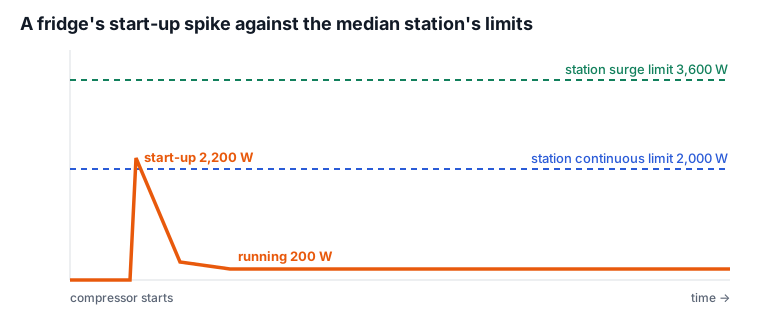
Because a fridge's running watts are small and its start-up spike is large. The table's full-size fridge runs at 200 W but needs about 2,200 W to start. Every current model has enough continuous output for the running figure, but 16 of them can't cover the start-up figure. Examples include the EcoFlow RIVER 3 Plus, EcoFlow RIVER 2 Pro, EcoFlow RIVER 2 Max, EcoFlow RIVER 2 and Anker SOLIX C300.
On paper, these stations look more than big enough for a fridge. If the start-up draw is above the surge rating, the compressor tries to start, the station hits its limit and its protection cuts the AC output. The fridge stays warm, and you may not notice until the food has spoiled.
A fridge with a variable-speed compressor may start more gently than the table assumes. If you own one of the stations above, plug the fridge in at home while the grid is still on and watch whether it starts and keeps running through a few cycles. Don't rely on it during an outage until you have seen it work. Our refrigerator page lists which stations clear the start-up figure.
What if a power station doesn't publish a surge rating?
Treat its continuous rating as the limit. 50 of the 56 current models publish a surge figure; the other 6 don't, and the table above counts those models at their continuous rating for start-up.
That is a conservative assumption. The inverter may well handle a short spike above its continuous rating, but without a published number you can't plan on it. If you need to start a motor load, a model that publishes its surge rating removes the guesswork.
What is the difference between peak and surge ratings?
Brands use "surge" and "peak" for the same idea: the most power the inverter can deliver for a short moment. The trouble is that "short" is not part of the figure: the surge ratings we record are in watts, with no duration attached. Among models that publish a figure, the median surge rating is 2.0× the continuous rating, and the lowest is 1.2×.
When you compare two stations, keep these points in mind:
- Duration matters as much as watts. A rating held for a few milliseconds can absorb an inrush spike. A compressor that takes longer to come up to speed needs the higher output for longer.
- Surge ratings aren't standardised. Two brands' figures may come from different test conditions, so a small difference on paper means little.
Leave a margin between the appliance's start-up watts and the station's surge rating rather than sizing to the exact number.
How do I start several motor loads from one power station?
Start them one at a time. The surge rating must cover the starting load plus everything already running, not the sum of every start-up figure.
Take a fridge and a chest freezer from the table. If both compressors start at the same moment, you need 2,200 + 2,200, or 4,400 W. If the freezer is already running when the fridge starts, you need 2,200 + 170, or 2,370 W. That difference decides whether a mid-size station works. After an outage, plug in one compressor, wait for it to settle, then plug in the next. Thermostats will eventually line up starts by chance, so a station with surge to spare is safer than one sized to the staggered figure.
Run the biggest motor first, then add smaller loads. Keep heating loads like a microwave or kettle off while a compressor may be starting. The sizing guide works through a full outage example with both a fridge and a freezer.
Do soft starters help a power station start an air conditioner?
Yes, when the start-up spike is what stops the station. A soft starter is a small electronic module wired into an air conditioner or pump. It ramps the motor up gradually instead of hitting it with full voltage, which lowers the start-up spike.
They are fitted in RVs, where a rooftop air conditioner's start-up current is the main barrier to running it from a generator or battery: Dometic lists 63–68 A locked-rotor against 12.4 A running for its 13,500 BTU unit (Dometic Rooftop Air Conditioner Installation Instructions (Form No. 3317817.000, Brisk II / Penguin II family), Dometic Corporation, 2021). See RV air conditioner starting current. Fitting one means wiring it into the appliance's electrical box, so check the appliance maker's guidance first. Use a kit made for your unit and have a qualified technician install it if you are not comfortable with the wiring.
Some appliances don't need one. Window and mini-split air conditioners and fridges sold as "inverter" or variable-speed models ramp their compressors up electronically instead of starting them at full voltage. If your appliance's manual describes a variable-speed compressor, check its listed start-up or maximum draw, because the table's figure assumes a fixed-speed start. For window units, see our window air conditioner picks.
What do well pumps and sump pumps need to start?
More than their running watts suggest, and sometimes a voltage portable stations don't offer. Franklin Electric's minimum generator size is 3 kW for a 1/2 hp two-wire well motor and 6 kW for 1 hp, written for engine generators (Franklin Electric AIM Manual - Submersible Systems, 60 Hz (M1311), Franklin Electric, 2026). A 230 V well motor also needs 240 V output, so check that the station lists it before you count on it.
Sump pumps are simpler when they run on 120 V, but makers don't always publish a start-up figure. Zoeller lists its 3/10 hp M53 at 9.7 A running on 115 V, about 1,100 VA, with no start-up figure (Zoeller Model M53 Mighty-Mate Catalog Sheet (53-0001), Zoeller Pump Company, 2024). Leave surge headroom. Wiring a station to a hard-wired pump is a job for a licensed electrician; see connecting backup power to a house and stations that can start a well pump.
What does an appliance label tell me about start-up surge?
The running figure, and sometimes nothing more. A label lists volts, amps or watts while running. Some, such as compressor and air conditioner plates, also list locked-rotor amps, shown as LRA, which is the current the motor draws when it is stalled or just starting.
If you find an LRA figure, multiply it by the voltage for an estimate of the start-up demand in volt-amps. A compressor marked 10 LRA at 120 V works out to 1,200 VA at start. That is a worst case, since the spike lasts only an instant, but it is the right number to compare against a surge rating.
If the label gives only running amps, multiply by the voltage for running watts, then use the start-up figure for that appliance type from the table. Where a maker publishes an input wattage separately from an output figure, as with microwaves, size by the input. Frigidaire, for example, rates its 8,000 BTU window air conditioner at 670 W when cooling but publishes no start-up figure (Frigidaire 8,000 BTU Window Room Air Conditioner with Wi-Fi - Product Specifications (FHWW083WBE / FHWW084WD1), Frigidaire, 2023). In that case, the table's window AC start-up value is the safer planning number.