Power station vs generator for a power outage
A power station is silent, fume-free and safe to run indoors, but it only holds the energy in its battery (the median current model holds 1,208 Wh). A fuel generator runs as long as you refuel it, but must stay outdoors. Which fits depends on what you need to run and for how long: the sections below size a fridge-and-lights outage plan against current models, and show where only a generator or a large expandable system covers whole-house loads for days.
How does a power station differ from a fuel generator?
| Power station | Fuel generator | |
|---|---|---|
| Where it can run | Indoors | Outdoors only, away from openings (Ready.gov: at least 20 feet from windows, doors and attached garages) |
| Energy available | Fixed by the battery; refill from the wall, car or solar | As long as there is fuel |
| Noise and fumes | None to near silent; no exhaust | Engine noise; carbon monoxide exhaust |
| Big loads | 13 of 56 current models deliver 3,000 W or more continuous | Depends on the model |
| Upkeep | Keep charged; no fuel storage | Fuel storage, oil, periodic running |
What is the safety rule for fuel generators?
Ready.gov's outage guidance says generators and fuel should always be used outdoors and at least 20 feet from windows, doors and attached garages, and to install carbon monoxide detectors on every level of the home. A power station has no exhaust, which is the main reason people choose one for apartments and indoor backup.
Which page answers what you need to keep running?
How long should you plan for an outage to last?
Plan for at least a full day without power, and two or more if you live where hurricanes or ice storms hit. Short outages are common but add little to the yearly total. Long ones are what decide whether a battery is enough.
In EIA's 2020 household survey, about 18% of US households had an outage that lasted more than 24 hours, most of them caused by weather. (2020 RECS Table HC2.1 Structural and geographic characteristics of U.S. homes, by housing unit type, 2020, U.S. Energy Information Administration, 2023)
A single bad year can be much worse than the average. EIA found that major events, led by three hurricanes, caused 80% of the hours Americans spent without power in 2024. (Hurricanes in 2024 led to the most hours without power in the United States in 10 years, U.S. Energy Information Administration, 2025) That same year, South Carolina customers averaged nearly 53 hours without power, mostly from one storm. (Hurricanes in 2024 led to the most hours without power in the United States in 10 years (with Electric Power Annual Table 11.4), U.S. Energy Information Administration, 2025)
A one-evening outage favors a battery on cost, noise and safety. A multi-day outage is where a generator's refueling advantage shows up, unless you can recharge the battery.
How long does a typical power station last in an outage?
A mid-size station runs a full-size fridge for most of a day, or a router for a couple of days, on one charge. The model closest to the median capacity in our data is the Jackery Explorer 1000 Plus, rated at 1,264 Wh. Using our calculated runtimes at 85% inverter efficiency, it would run:
- A full-size fridge: about 16 h, because the compressor cycles on and off.
- A Wi-Fi router and modem: about 2.2 days.
- A CPAP with its heated humidifier: about 19 h, so roughly two nights.
Those runtimes are for one load at a time. Run the fridge and router together and both figures shrink. The power station runtime calculator adds loads up for you.
You can stretch a fridge runtime by keeping the door shut. Ready.gov says a closed fridge keeps food cold for about 4 hours without power and a full freezer for about 48. (Power Outages, FEMA / Ready.gov, 2026) Those are rules of thumb that depend on room temperature and door openings, but they mean the station only has to cover the gap. See whether a power station can run your refrigerator for per-model runtimes.
Big resistive loads are the exception. Anything that draws a full 15 A, 120 V circuit (1,800 W) would empty a station of the median capacity in about 34 minutes. That is why cooking, heating and air conditioning are where generators keep their edge.
Can a power station get you through a three-day outage?
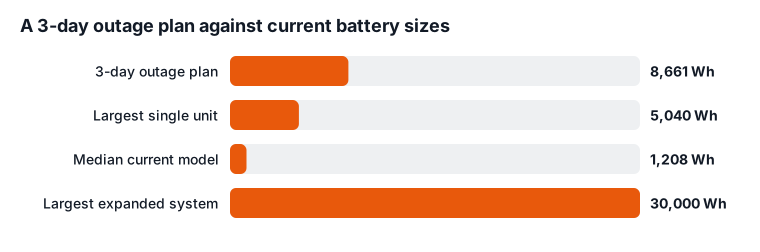
No single current model can cover a three-day outage of basic loads on one charge. You need an expandable system with extra batteries, or a way to recharge during the outage. Here is the worked example: a fridge, a router, some lights and phone charging for 72 hours.
| Load | Watts | Hours × duty | Wh |
|---|---|---|---|
| Full-size fridge | 200 | 72 × 0.33 | 4,752 |
| Wi-Fi router / modem | 20 | 72 | 1,440 |
| Six LED bulbs, 5 h a night | 54 | 15 | 810 |
| Phone charging | 40 | 9 | 360 |
| Total ÷ 0.85 | 314 | 72 h | 8,661 |
That plan needs about 8,661 Wh from the battery. The running load peaks at only 314 W, or about 2,314 W for the moment the fridge compressor starts, so output isn't the problem. Capacity is.
- Single units: 0 of 56 current models hold enough on their own. The largest single unit in our data holds 5,040 Wh, about 58% of the need.
- Expanded systems: 13 models can reach it once you add their extra batteries. The biggest expandable system we list, the Jackery Explorer 5000 Plus, reaches 30,000 Wh fully expanded.
- The fridge alone accounts for most of the total: 4,752 Wh ÷ 0.85, or about 5,591 Wh over three days.
Cutting the fridge to a few hours on and a few hours off, or skipping the router overnight, brings the target down a lot. Browse power stations of 3,000 Wh and up if you want to cover the full plan from storage.
How can you recharge a power station when the grid is down?
You can recharge from solar panels, from a car's 12 V socket, or from a generator, and each one fills the battery at a very different speed. Wall charging is fastest, but it only helps once power returns or if you have a generator.
- Wall power or a generator: of the 42 models that publish a full AC recharge time, the median is 70 minutes and the fastest is 49 minutes.
- Solar: 20 current models accept 1,000 W or more of solar input. Even at full rated panel output, a lab-condition figure, refilling a 1,264 Wh battery from a 1,000 W array takes at least about 1.3 hours of perfect sun. Every watt short of the rating adds time. Our guide to solar charging a power station and the solar recharge calculator cover realistic output.
- A car: the 12 V socket is the slowest option. It works for topping up phones and lights, but not for refilling a large battery in a day. Run the car outdoors only, for the same carbon monoxide reasons as a generator.
Rooftop or plug-in solar tied to the grid doesn't help on its own. Utah's plug-in solar law, for example, requires those devices to shut off during an outage so they can't energize the home's wiring. (H.B. 340 Solar Power Amendments (2025 General Session, Enrolled Copy), Utah State Legislature, 2025) Panels plugged directly into a station's solar input keep working, because the station isn't connected to the grid.
Is a power station or a generator cheaper per hour of backup?
Which costs less depends on how long the outage runs, and we can only put a number on one side: what a battery costs per stored watt-hour. The two costs work differently. A battery's cost is paid up front for each watt-hour you store. A generator's cost keeps going as long as you buy and store fuel.
Across current models, the median is 1.45 Wh of capacity per dollar of list price. At that ratio, 1,000 Wh of storage costs about $689, and storing the full three-day plan above would cost roughly $6,000. Expansion batteries are priced differently from complete units, so treat that figure as a rough scale only.
Fuel is harder to put a number on, so think about logistics instead:
- If you store fuel, follow the fuel and generator makers' guidance on storage life and stabiliser.
- Gas stations may be closed or have long lines during a regional outage, because their pumps need power too.
- Check the generator's manual for its oil-change and test-run schedule before an outage, not during one.
A station's upkeep is mostly keeping it charged between outages.
Which is better for an apartment or a quiet neighborhood?
A power station is the practical choice for apartments, condos and anyone without a yard. It makes no exhaust, so it can sit next to your bed or in a closet. It has no engine, so the only sound is a cooling fan under heavy loads.
A generator needs outdoor space well away from windows and doors, which an apartment, townhouse or small lot may not have. Even where you have room, engine noise through the night can bother neighbors and break local quiet-hour rules.
If you rent, a station also needs no installation and moves with you. Our page on power stations for apartments with balcony solar covers setups that fit small spaces.
When is a fuel generator still the better answer?
A generator is still the better choice when you need high power for many days and you can run it safely outdoors. A few situations push the decision that way:
- Heating and cooling: space heaters and air conditioners draw hundreds to thousands of watts for hours, which drains any single station quickly.
- Well pumps: many need 240 V and a large start-up surge. Check whether a power station can run a well pump before you rely on one.
- Week-long outages in areas without sun: winter storms bring short days and snow-covered panels, which limits recharging.
- Whole-house loads: only 13 of 56 current stations deliver 3,000 W or more continuous, and running several major appliances at once needs that much or more.
Feeding household circuits from either source needs a transfer switch or inlet installed by a licensed electrician. Our guide to connecting a power station to your house safely explains the options.
Can you use a power station and a generator together?
Yes, and for long outages each one covers a gap the other leaves. The generator runs outdoors for a few hours during the day to recharge the station and run big loads. The station takes over at night, indoors and silent, for the fridge, router, lights and medical devices.
Here is how the timing works. If a generator can supply a station's full AC charging input, a station at the median published AC recharge time refills in about 70 minutes. That means the generator might run only an hour or two a day instead of all night. Check that the generator's running watts exceed the station's rated AC input before you count on full-speed charging.
This approach also means you can buy a smaller station, sized for one night of essentials rather than the whole outage. Our guide on how to size a power station walks through that math, and the best power stations for home backup lists the models with the most capacity.
Runtimes and costs here are calculated from published specs and list prices, using the site's 85% inverter efficiency assumption. They are not measured results.
What do official documents say about generator safety?
The US Consumer Product Safety Commission estimates generators were linked to 892 carbon-monoxide deaths from 2012 to 2022, 41% of all such deaths from consumer products and more than heating systems (622). A battery station produces no exhaust.
Non-Fire Carbon Monoxide Deaths Associated with the Use of Consumer Products: 2022 Annual Estimates
In 553 generator carbon-monoxide deaths inside homes that CPSC reviewed (2012–2022), two-thirds involved no attempt to vent the exhaust, and 64% of the incidents happened in homes under 1,500 sq ft. Small homes leave little room to run a generator safely.
In 5% of those deaths the generator was outdoors but close enough to a window, vent or air conditioner for carbon monoxide to get in. One case involved a generator with a certified CO shutoff.
The same EIA survey found 17.7 million US homes (about 14%) had a backup generator. Almost all were single-family detached houses, which suggests apartment dwellers have few options besides battery stations.