Solar charging a power station: what limits the speed
Recharge speed is the smaller of two numbers: what your panels actually deliver, and the station's maximum solar input. Current models accept from 100 W to 4,000 W of solar (median 800 W). Panels above that limit add nothing.
How do you work out solar recharge time?
Hours of strong sun to recharge ≈ capacity (Wh) ÷ the smaller of (panel watts × real-world output) and the station's solar input limit. Our calculator defaults to panels delivering 75% of their rating; change it to match your panels.
Example: the Jackery Explorer 2000 v2 holds 2,042 Wh and accepts up to 400 W. With 400 W of panels at 75% it needs about 6.8 hours of strong sun, or about 1.5 days if you get 4.5 hours of strong sun a day.
Why does solar input voltage matter?
Every station also has a solar input voltage range. Panels wired in series add their voltages; going over the range can damage the input. Check the range on the spec sheet before wiring panels in series, especially in cold weather, when panel voltage rises.
What do official documents say about real solar panel output?
NREL's PVWatts model assumes a fixed solar array loses 14% of its rated output before the inverter: dirt (2%), shading (3%), mismatch (2%), wiring (2%) and other small losses. Our 75% assumption for portable panels allows for those losses plus heat and less-than-ideal angles.
NREL's PVWatts assumes standard panels lose about 0.47% of output for every °C above 25 °C (0.35% for premium panels). A panel at 60 °C on a summer afternoon can lose about 16% from heat alone.
NREL's data from US solar fleets shows snow cuts winter output by 5–10% on average and 10–30% in snowy months. Portable panels can be brushed off and re-angled, so you can claw most of that back.
NREL's study of a 7–8 GW US solar fleet found output fell by a median 0.75% a year, faster in hot climates (0.88%) than cool ones (0.48%). Portable panels handled and folded often may age faster.
What should you read next?
How many hours of sun does each size of power station need?
A small station refills in one sunny afternoon, while a large one can take several days on a modest panel. The table shows four stations from small to very large with four panel sizes. Each figure is hours of strong, direct sun, using our calculator's 75% real-world panel output and capped at each station's published solar input limit.
| Model | Wh | Max solar W | 100 W panels (h) | 200 W (h) | 400 W (h) | 800 W (h) | Check price |
|---|---|---|---|---|---|---|---|
| Goal Zero Yeti 300Amazon | 297 | 200 | 4.0 | 2.0 | 1.5 | 1.5 | On Amazon |
| Goal Zero Yeti 1000Amazon | 998 | 900 | 13.3 | 6.7 | 3.3 | 1.7 | On Amazon |
| Jackery Explorer 2000 v2Amazon | 2,042 | 400 | 27.2 | 13.6 | 6.8 | 5.1 | On Amazon |
| Goal Zero Yeti PRO 4000Amazon | 3,994 | 3,000 | 53.2 | 26.6 | 13.3 | 6.7 | On Amazon |
Read across a row to see where extra panels stop helping. The Goal Zero Yeti 300 takes the same time with 400 W or 800 W of panels, because it hits its 200 W input limit first. The Goal Zero Yeti PRO 4000 keeps getting faster all the way to 800 W, because its 3,000 W limit sits above that.
Read down a column to see how capacity drives time. With a single 100 W panel, only the smallest station refills in one good day. Everything larger needs more panels or more days. If you plan to live off solar for a week, the bottom rows show why a big battery on a small panel is a poor match.
Hours of strong sun are fewer than hours of daylight. Morning and late-afternoon light is weaker, so plan in strong-sun hours. The solar recharge calculator runs the same math for any model and panel size.
Which power stations recharge fastest from solar?
The fastest stations have a solar input limit that is large compared with their battery. Divide capacity (Wh) by maximum solar input (W) and you get the hours to refill at full input.
Across current models, the best ratio belongs to the EcoFlow DELTA 3 Plus, at about 1.0 hours at full input. The median is 2.1 hours. The slowest is the Jackery Explorer 2000 v2, at about 5.1 hours, because a large battery sits behind a modest input.
Of the 51 models that publish a solar limit, 20 accept 1,000 W or more, and 11 are capped at 300 W or less. A capped station is fine for topping up at a campsite. It is a poor fit if solar is your main power source in a long outage.
Full input is a best case that needs enough panel wattage, good sun and the right voltage. And a good ratio on a small station still means a small amount of energy. A station that refills in an hour but holds little may not get you through the night. Pick capacity first with the sizing guide, then use this ratio to choose between models of similar size. Our best power stations for solar charging lean on the same ratio.
How many watts of solar panels should you buy for your station?
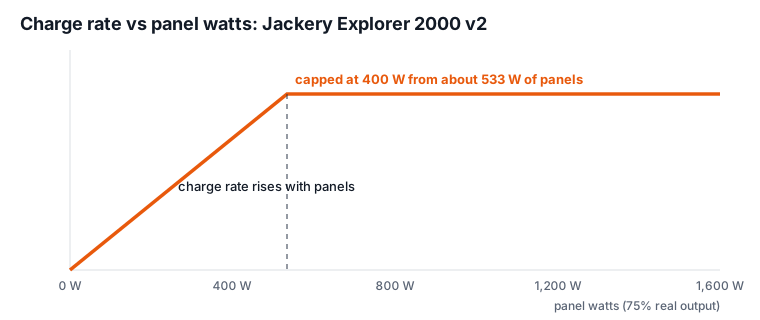
Buy enough panel wattage that real-world output roughly matches the station's input limit. Because panels deliver about 75% of their rating in our model, that wattage is the input limit divided by 0.75.
Worked example: the Jackery Explorer 2000 v2 accepts up to 400 W. 400 ÷ 0.75 ≈ 533 W of panels would fill that input on a good day. With 400 W of panels it needs about 6.8 hours of strong sun. Going much above 533 W adds cost and weight with no gain in strong sun. For the Goal Zero Yeti 300, with a 200 W limit, the same math gives about 267 W.
There is one good reason to go higher. In winter, on hazy days or with panels lying flat, output falls well below 75%, and extra panels lift you back toward the input limit. This only works within the station's voltage and current limits, so read the wiring section before you add panels.
Why do solar panels deliver less than their rated watts?
A panel's rating comes from a lab test under ideal light at a cool cell temperature, and any shortfall from those conditions costs output. Several losses stack up.
- Heat. Panels lose output as they warm up, so a hot, clear afternoon can deliver less than a cool, clear morning.
- Angle. Output peaks when sunlight hits the panel square on. A panel lying flat catches morning and evening light at a steep slant.
- Dirt. Dust, pollen and bird droppings block light. Wipe panels before setting them out.
- Shade. A shadow across part of a panel can cut its output far more than the shaded area suggests, because the cells are wired in strings.
- Clouds and haze. Thin cloud cuts output a lot; heavy overcast reduces it to a trickle.
- Cables. Long, thin extension cables lose a little more.
Our 75% figure is our adjustable default for these losses on portable panels, so change it in the calculator to match yours. The official figures further down show how big some of them are for fixed arrays. On a hot, hazy day with panels lying flat, you can fall well below 75%. The cheapest fix is to prop panels up facing the sun and re-aim them every couple of hours.
Should you wire solar panels in series or parallel?
Wire in series when you need more voltage to reach the station's input range, and in parallel when series would push you over its voltage limit. The station's spec sheet decides which.
In series, panel voltages add and current stays the same as one panel. In parallel, currents add and voltage stays the same. Power is volts × amps either way, so two identical panels give the same watts in both layouts. What changes is whether those volts and amps fit the station's input window.
- Series suits high-voltage inputs and long cable runs. The weakness: shade on one panel drags down the whole string.
- Parallel suits stations with a low maximum voltage, and shade on one panel hurts the others less. The weakness: current rises, so you can hit the station's amp limit, and you need a parallel adapter.
Before wiring, check the station's input voltage range, maximum input current and maximum input watts, then the panel's open-circuit voltage on its label. Panel voltage rises in cold weather, so leave headroom below the station's maximum. If you are unsure, use the panel and cable combinations the station's maker lists. Some stations have two solar inputs, which lets you run two separate strings without a combiner.
Are rigid or folding solar panels better for a power station?
Folding panels suit camping and occasional use; rigid panels suit a fixed spot such as a roof, shed or RV. Both charge a station the same way once the voltage fits.
Folding panels pack small; check whether yours comes with a kickstand and a cable that fits your station. Folding and handling add wear, and a panel laid on the ground with little airflow behind it runs hotter; NREL's PVWatts model assumes about 0.47% less power per °C for standard panels (PVWatts Version 5 Manual (NREL/TP-6A20-62641, A. Dobos), National Renewable Energy Laboratory, U.S. DOE, 2014). Rigid glass panels are heavy to move, so check their weather rating and mount them where they will stay, as in an RV power setup or a fixed backup array. Thin flexible panels can stick to a curved van roof, but they lie flat with no airflow behind them, so they run hotter; for van life and off-grid camping, weigh that against the convenience.
How do you plan solar charging for winter?
Plan for far fewer hours of strong sun in winter, and size panels or capacity to match. Days are shorter, the sun sits lower and clouds are more frequent, so a setup that refills in one summer day can need several winter days.
Worked example: the Jackery Explorer 2000 v2 needs about 6.8 hours of strong sun with 400 W of panels. If a winter day gives you half the strong sun of a summer day, the recharge takes twice as many days. Adding panels up to about 533 W, as worked out above, wins some of that back.
- Tilt panels steeper. The low winter sun favors a steep angle.
- Clear snow and frost. Portable panels can be brushed off in a minute.
- Watch voltage on cold mornings. A series string near the station's limit in summer can exceed it on a frosty morning.
- Keep the battery warm enough to charge. Lithium batteries charge poorly when cold, and a station may limit or block charging below a set temperature. Check the charging temperature range on the spec sheet and keep the station indoors while panels sit outside. Our battery chemistry guide covers how each chemistry handles cold.
- Start full and watch your loads. Top up from the wall while the grid is up. Anything the station powers during the day comes out of the solar input, so check your loads with the runtime calculator.
Hours in this guide are calculated from published specs and a 75% panel output assumption, not measured. Real results depend on location, season, weather and panel setup.