Connecting a power station to your house safely
Larger power stations can feed chosen home circuits through a transfer switch or an inlet with an interlock, installed by a licensed electrician. Never plug a power source into a wall outlet to power the house: the Red Cross calls this backfeeding and warns it can electrocute utility workers, neighbors and your household.
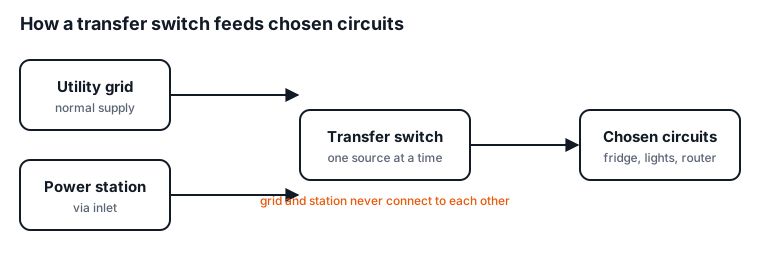
What are the safe ways to power home circuits?
- Extension cords from the station to individual appliances. No wiring changes.
- Manual transfer switch wired into the panel for a few chosen circuits, so the house is cut off from the grid while the station feeds it.
- Inlet box with a breaker interlock, which does the same at the main panel.
- Brand home-backup kits: several brands sell their own panel or switch accessories; check that your model supports them.
Wiring into the panel is a job for a licensed electrician and may need a permit where you live.
What should you never do?
Plugging a power source into a wall outlet with a two-male-ended cord. The Red Cross warns that this "backfeeding" puts utility workers, your neighbors and your household at risk of electrocution.
Which stations can carry home circuits?
13 of 56 current models deliver 3,000 W or more continuous at 120 V, the usual starting point for running several household circuits. 1 also publishes a 240 V output, which some well pumps, dryers and central systems need; check that figure separately, because a station's 240 V rating can differ from its 120 V rating.
Which circuits should you put on a power station?
Put the circuits for your fridge, freezer, internet and a few lights on the station first, then add others only if the station's continuous rating has room. Those four keep food safe and keep you connected, and together they draw far less than a kitchen or heating circuit.
This table adds circuits in the order we suggest above, basics first, and counts how many current models can carry each set at once.
| Circuits running together | Running W | Models with enough continuous output |
|---|---|---|
| Fridge + freezer + router + lights | 450 | 50 |
| Add a 1,000 W microwave | 1,450 | 41 |
| Add a 1,500 W space heater | 2,950 | 13 |
The first set fits almost every model. Adding a microwave still leaves most mid-size and larger stations in range. Adding a space heater on top drops you to the 13 models rated at 3,000 W or more, such as Jackery Explorer 5000 Plus, Anker SOLIX F3800 Plus, Anker SOLIX F3800, EcoFlow DELTA Pro 3, EcoFlow DELTA Pro and EcoFlow DELTA 3 Ultra Plus.
Circuits worth considering after the basics:
- Sump pump: Zoeller lists its 3/10 hp M53 at 9.7 A running on 115 V, about 1,100 VA, with no published start-up figure. (Zoeller Model M53 Mighty-Mate Catalog Sheet (53-0001), Zoeller Pump Company, 2024) Budget for it as if the VA figure were watts and leave extra headroom. See whether a power station can run a sump pump.
- Furnace blower or gas boiler controls: useful in winter, but the motor's start-up draw matters as much as its running watts.
- A bedroom circuit: handy for a CPAP, fans and phone charging overnight.
Leave electric ranges, water heaters, dryers and central air off the list. They draw more than a portable station can supply.
How do you pick circuits that stay within the station's continuous rating?
Add up the running watts of everything that could run at the same time on your chosen circuits, and keep that total under the station's continuous AC rating with room to spare. The median current model is rated 2,000 W continuous.
- List each load on each circuit. A circuit is a breaker, not a room, so one breaker may cover outlets in several rooms.
- Use the input watts from the label. Panasonic rates its 1,100 W microwave at 1,500 W of power draw, because the advertised number is cooking power. (Features and Specifications - Microwave Oven - NN-SU696SAWH, Panasonic North America, 2026) With that microwave, the 450 W basics plus the microwave come to 1,950 W, which leaves a 2,000 W station, the median rating, only 50 W of margin.
- Allow for motor starts. One small fridge compressor's datasheet lists start current about 5.6 times its running current, for under a second. (Technical Data Sheet B60C5BL R600a 110-120V 60Hz, Danfoss, 2020) A station has to cover that spike on top of everything already running. Our guide to surge vs running watts explains how to check it.
- Remember breaker limits. A standard 15 A, 120 V circuit carries up to 1,800 W, and a 20 A circuit up to 2,400 W. Whichever is lower, the breaker or the station's continuous rating, is your limit; the median current model is rated 2,000 W.
- Plan to stagger big loads. Run the microwave while the space heater is off. A transfer switch lets you turn individual circuits off, which makes this easy.
How do the panel connection methods work, step by step?
All three methods do the same job: they cut chosen circuits off from the grid before the station powers them, so power can't flow back onto the utility lines. They differ in where the switching happens and how many circuits you can reach. A licensed electrician should install any of them.
Manual transfer switch
A small sub-panel mounts next to your main panel, and the electrician moves a handful of chosen circuits into it. During an outage you:
- Turn off or unplug the large loads on the chosen circuits.
- Connect the station to the switch's inlet or power cord with a cord rated for it.
- Turn the station's AC output on.
- Flip each circuit's switch from the grid position to the backup position, one at a time, watching the station's load display.
- When grid power returns, flip each circuit back to the grid position before you turn the station off.
The circuit count is fixed when it's installed, which makes it a simple, hard-to-misuse choice.
Inlet box with a breaker interlock
An outdoor or garage inlet connects to a dedicated breaker in the main panel. A metal interlock plate makes it physically impossible to turn on that breaker while the main breaker is on. During an outage you turn off the main breaker, slide the interlock, connect the station, turn on the inlet breaker and then switch on only the circuits you want. Every circuit in the panel is available, so you have to manage the load yourself by turning breakers off.
Brand home-backup panels and kits
Some brands sell their own transfer panels or switch kits built for their stations. Features vary by brand, and each one works only with specific models. Check the manufacturer's compatibility list for your exact model, and have an electrician install it to the maker's instructions.
Do you need 120 V or 240 V output?
You need 120 V output for ordinary outlets and most chosen circuits, and 240 V output only for loads like well pumps and some HVAC equipment. A US home on split-phase service has two 120 V legs that give 240 V between them. Standard outlets and lights each run from one leg.
A 120 V-only station can power 120 V circuits, but how it connects to both legs of the panel is a decision for your electrician. 240 V loads won't run from it at all. Only 1 current model publishes a 240 V output: the Jackery HomePower 3600 Pro Max (4,000 W at 240 V).
If a well pump is on your list, check whether a power station can run a well pump and the best power stations for well pumps before you choose a switch.
What should you ask an electrician before installing one?
Ask which method suits your panel, which circuits it can reach, and how it will match your station's output and plug. Bring your station's model and spec sheet so they can see its continuous rating, its AC outlets and whether it has 240 V output.
- Is my panel compatible with an interlock kit, or is a manual transfer switch the better fit?
- Which of my circuits are on which leg, and does that matter with a 120 V-only station?
- What inlet and cord match my station's highest-rated AC outlet?
- How do the station's grounding and neutral connect to the house wiring?
- Does this job need a permit and inspection where I live, and will you pull it?
- Can you measure the running and start-up draw of the circuits I want?
Do you need a permit to install a transfer switch?
You may, because adding a transfer switch or inlet changes your panel wiring. Rules vary by city and county, so ask your local building department or your electrician.
An inspection checks that the switch is the right type for your panel, that the wiring and breakers are sized correctly and that the setup can't backfeed the grid. Skipping the permit can cause trouble with home insurance claims or a future sale, and unpermitted work may need to be redone.
How does a transfer switch stop backfeeding?
A transfer switch or interlock makes it impossible for your house wiring to be connected to the grid and the station at the same moment. That break is what protects line workers.
The utility transformer outside your home works in both directions. Power pushed out of your panel gets stepped up to line voltage on wires that crews believe are dead. A two-male-ended cord in a wall outlet has no such break, and it leaves a live, exposed plug on the other end.
Stations themselves are getting a similar safeguard for pass-through use. The latest edition of UL 2743, the safety standard for portable power stations, adds backfeed-protection requirements for units with AC pass-through, with certification required by September 24, 2027, according to Intertek's summary. (Standards Update Notice (SUN): ANSI/CAN/UL 2743 Portable Power Packs [ANSI/CAN/UL 2743:2025 Ed.3], Intertek, issued March 18, 2026, 2026) It applies to the station's own pass-through circuit, not your house wiring, so it doesn't replace a transfer switch. Our guide to UPS vs EPS switchover covers pass-through in more detail.
How long can a power station run your home circuits?
A mid-size station runs the basic circuits for a few hours to most of a day, and an expandable system can stretch that to several days. The difference comes from how often your appliances actually run.
Take the 1,208 Wh median capacity. If the 450 W basic set ran nonstop, it would last about 2.3 hours. Fridges and freezers cycle, though. ENERGY STAR's median certified full-size fridges average about 41 W to 73 W over a year, depending on style, in lab tests with the door shut. (ENERGY STAR Certified Residential Refrigerators (dataset), ENERGY STAR, 2026) Your own fridge may use more than its lab rating, but while the compressor rests, its average stays below the running wattage. The power station runtime calculator works this out for your own loads.
For longer outages, 23 current models accept extra batteries, and 13 can reach 10,000 Wh or more fully expanded. At 10,000 Wh, even the nonstop 450 W case lasts about 19 hours. Browse power stations of 3,000 Wh and up or the best power stations for home backup to compare them.
Wiring a power source into a home panel is a job for a licensed electrician and may need a permit. Runtimes here are calculated from published specs at 85% inverter efficiency, not measured.
What do official documents say about connecting backup power to a house?
CPSC warns never to power house wiring by plugging a generator into a wall outlet (backfeeding). It can electrocute utility workers and neighbours on the same transformer, and it bypasses the home's circuit protection. The same applies to a power station, which is why a transfer switch or inlet is the safe route.
CPSC Safety Alert: Portable Generator Hazards (Publication 5123/102021)
Franklin Electric's minimum generator size is 3 kW for a 1/2 hp two-wire well motor and 6 kW for 1 hp, written for engine generators. Most 230 V well motors also need a 240 V output, which most portable stations lack.
Franklin Electric AIM Manual - Submersible Systems, 60 Hz (M1311)
CPSC found power outages were the leading reason people were running a generator in fatal carbon-monoxide incidents it investigated (139 deaths, 2012–2022), and a CO alarm was known to be present in only 4% of these deaths.