EcoFlow vs Jackery
Both sell a full range, from small camping units to home-backup systems. EcoFlow lists 14 current models and Jackery 14. Across the lineups, Jackery models accept more solar input at the top end; Jackery gives more capacity per list dollar. Compare the specific models you're choosing between.
How do the two lineups compare on paper?
| EcoFlow | Jackery | |
|---|---|---|
| Current models | 14 | 14 |
| Capacity range (Wh) | 243–4,096 | 256–5,040 |
| Expandable models | 8 | 6 |
| Median rated cycles | 3,000 | 4,000 |
| Median UPS switchover | 10 ms | 10 ms |
| Median Wh per list $ | 1.46 | 1.66 |
| Highest solar input (W) | 2,600 | 4,000 |
Medians across each brand's current models with published values, from official pages.
Which EcoFlow and Jackery models have we compared head to head?
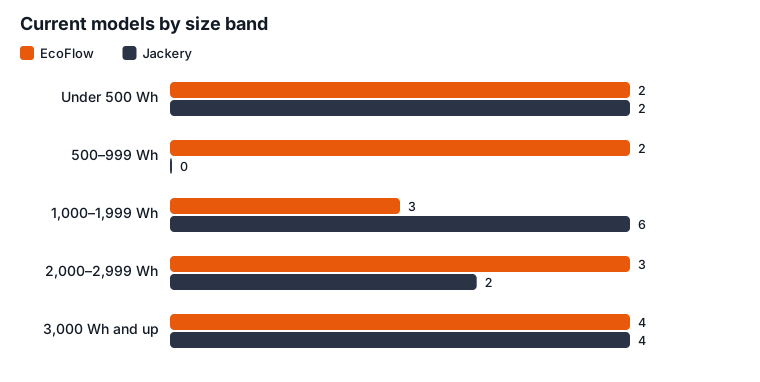
How do the EcoFlow and Jackery lineups compare by size?
Both brands sell everything from small camping units to home-backup stations. Jackery has no current model in the 500–999 Wh band. The table lists each brand's current models by rated capacity, with list prices from official stores.
The bands tell you where each brand puts its effort. EcoFlow has two under 500 Wh, two at 500–999 Wh, three at 1,000–1,999 Wh, three at 2,000–2,999 Wh and four at 3,000 Wh and up. Jackery has two under 500 Wh, none at 500–999 Wh, six at 1,000–1,999 Wh, two at 2,000–2,999 Wh and four at 3,000 Wh and up. A brand with more models in a band gives you more steps to choose between, which matters most in the popular 1,000–1,999 Wh range. The single largest unit of the two brands is the Jackery Explorer 5000 Plus.
If you already know the capacity you need, start in that row. If one brand has nothing in your band, the size pages such as 500–999 Wh power stations show what other brands offer there.
Which brand gives you more battery for the money?
Jackery does, on list prices. The median Jackery model gives 1.66 Wh per list dollar, against 1.46 Wh for EcoFlow.
Put another way, every $100 of list price buys about 166 Wh of capacity at Jackery's median and about 146 Wh at EcoFlow's. A gap like that adds up on big stations.
Each brand's best-value model:
- EcoFlow: EcoFlow DELTA 3 Ultra, at 1.92 Wh per list dollar.
- Jackery: Jackery HomePower 3000, at 2.05 Wh per list dollar.
As a worked example, the EcoFlow pick holds 3,072 Wh at a list price of $1,599, and the Jackery pick holds 3,072 Wh at $1,499. Divide capacity by price for any pair you're weighing and you get the same comparison.
Two cautions apply. List prices change and sales are common, so a discount can flip the result for any pair. Wh per dollar also ignores what else you get, such as inverter output, solar input and expansion. Use it to shortlist, then check the current price on each model page.
Which brand is lighter for the capacity?
Compare each brand's lightest-for-capacity model. The Jackery Explorer 2000 v2 stores 52 Wh per pound (2,042 Wh at 39.5 lb), against 46 Wh per pound for the EcoFlow DELTA 3 Max (2,048 Wh at 44.8 lb).
A few Wh per pound sounds small, but on a 2 kWh station it is several pounds. If you lift a station in and out of a car or carry it to a campsite, that difference is noticeable.
Weight per Wh matters most for stations you move often. For a unit that sits by a fridge or in a closet for outages, it matters far less than price and expansion. In our data, the smallest models in both lineups carry fewer Wh per pound than these two.
Which brand lets you add more battery later?
EcoFlow has 8 expandable models and Jackery 6. The largest expanded system is 30,000 Wh for Jackery and 12,000 Wh for EcoFlow.
Both top figures come from each brand's flagship: the Jackery Explorer 5000 Plus for Jackery and the EcoFlow DELTA Pro 3 for EcoFlow. Below the flagships, expansion ceilings are much lower, and some popular models can't expand at all.
Expansion matters if you plan to start small and grow into home backup. Buying one expandable station now and an extra battery later can cost less up front than buying a large station outright. Check three things on the model page: whether it expands, which battery packs it accepts, and its maximum expanded capacity.
For powering house circuits from a big expanded system, read our guide on connecting a power station through a transfer switch, and use a licensed electrician.
Which brand charges faster from solar?
Compare the top end first. Jackery's highest rated solar input is 4,000 W, against 2,600 W for EcoFlow.
Those figures come from each brand's largest stations. Most models in both lineups accept far less, and the small camping units take only a fraction of it. A high input rating also only helps if you own enough panels to use it.
Solar input decides how fast you can refill a station off-grid. For a given panel setup, the rated input caps the charge rate, and real panels deliver less than their rating. To see how long a specific station and panel setup would take, use the solar recharge calculator.
Do EcoFlow and Jackery switch over equally fast as a UPS?
Their medians match. Among models that publish a figure, the median switchover is 10 ms for EcoFlow and 10 ms for Jackery, from 12 and 12 models.
The spread differs. EcoFlow's published times run from 10 ms to 30 ms, with the slowest being the EcoFlow RIVER 2 Pro, EcoFlow RIVER 2 Max and EcoFlow RIVER 2. Jackery's run from 0 ms to 20 ms, with the slowest being the Jackery Explorer 240 v2, Jackery Explorer 1000 v2, Jackery Explorer 1500 Ultra, Jackery Explorer 2000 v2 and Jackery HomePower 3000.
If you plan to keep a desktop or NAS running through outages, check the exact figure on the model page. Our guide to UPS vs EPS switchover times explains what the numbers mean for each kind of device.
Do EcoFlow and Jackery use the same battery chemistry?
Almost entirely, yes. Every current EcoFlow and Jackery model in our data uses LiFePO4 cells, with one exception: the Jackery Explorer 300, which uses NMC.
The chemistry matters for lifespan. In Sandia National Laboratories' multi-year cell tests, LiFePO4 cells lasted 2,500 to 9,000 full cycles before falling to 80% of their capacity, against 200 to 2,500 for NMC (Degradation of Commercial Lithium-Ion Cells as a Function of Chemistry and Cycling Conditions (Preger et al., J. Electrochem. Soc. 167 120532), Sandia National Laboratories / The Electrochemical Society, 2020). Those were small lab cells, not finished power stations, but the gap matches the cycle ratings brands publish.
From 500 Wh up, that makes chemistry a non-issue between these two brands. The one case where it counts is the under-500 Wh band. If you plan to cycle a small station often, for example every weekend or every night for a CPAP, the LiFePO4 options in that row are built for more cycles. The NMC model may suit occasional use, but check its rated cycles against how often you'll use it.
Median rated cycles in the table at the top of this page differ between the brands, but both medians come from LiFePO4 models. Treat rated cycles as the maker's claim under its own test conditions.
Should you pick EcoFlow or Jackery for camping, CPAP, home backup or solar?
Pick by the model that fits the job. The brand matters less than size, weight and price within your band.
- Camping and weekends. EcoFlow has two and Jackery two models under 500 Wh. A 500–999 Wh station suits longer trips with a small fridge or lights; check the table above for which brand has one. See the best power stations for camping.
- CPAP. ResMed rates the AirSense 11 at 56.1 W typical (AirSense 11 User Guide (398181, ANZ English/multi), ResMed Ltd, 2023). At the site's 85% efficiency, the 1,024 Wh Jackery HomePower 1000 v2 delivers about 870 Wh, or roughly 16 hours at that draw. The 243 Wh EcoFlow RIVER 2 delivers about 207 Wh, or roughly 4 hours, which may not cover a full night at that draw. Follow your device maker's guidance on battery power, and see the best power stations for CPAP.
- Home backup. Look at the 2,000 Wh and larger rows, then weigh price per Wh against expansion. Weigh Jackery's higher median capacity per dollar against how many expandable models each brand offers. See the best power stations for home backup.
- Solar. Compare the solar input of the specific models in your size band, since the flagship figures above don't apply to smaller units.
Where does each brand lean?
Here is where each brand comes out ahead on the computed data:
- Jackery: higher median Wh per list dollar, the lighter best-in-lineup station per Wh, the highest solar input, the largest expanded system, a higher median rated cycle count and the fastest published switchover.
- EcoFlow: more expandable models.
Jackery has no current model in the 500–999 Wh band.
Neither list covers apps, warranties, support or long-term reliability. We don't have verified data on those, so check each brand's official pages and recent owner feedback. The EcoFlow brand page and the Jackery brand page list every current model with its specs.
Why should you compare models instead of brands?
The gaps inside each lineup are bigger than the gaps between the two brands. A brand median hides that spread.
For example, EcoFlow's best-value model gives 1.92 Wh per list dollar, well above the brand median of 1.46. Jackery shows the same pattern, from 1.66 at the median to 2.05 at the top. Switchover ratings, solar input and expansion vary just as widely within each brand. A well-chosen EcoFlow can beat an average Jackery on any one of these specs, and the reverse is just as true.
So narrow the field by size band first, then put two or three specific models side by side. Line up the specs that matter for your use: capacity and price for home backup, weight for camping, switchover time for a computer, and solar input for off-grid charging. Ignore the logo until the specs are close, then let current price decide. Our power station comparisons do that model by model, including EcoFlow and Jackery models against other brands.