Generator carbon monoxide deaths
Portable generators were linked to an estimated 892 carbon monoxide deaths in the U.S. from 2012 through 2022, 41% of all non-fire CO deaths from consumer products, according to the CPSC. Most happened at home with the generator running inside. Below are the deaths each year, where they happened and why, and who died.
Key findings
Portable generators were linked to an estimated 892 carbon monoxide deaths from 2012 through 2022, 41% of all non-fire CO deaths from consumer products (CPSC).
CPSC estimates 93 generator CO deaths in 2022, out of 274 from all consumer products. The highest generator estimate in the series is 107, in 2021.
70% of the 789 reported generator deaths (2012–2022) happened at home, and in 73% of home deaths the generator was inside the house, in a basement or in an attached garage.
Power outages were the reason for running the generator in 139 deaths, and hurricanes alone were linked to 55. 44% of deaths came in November to February.
Where alarm status was known, 83% of victims had no working CO alarm. CPSC projects that its proposed generator rule would prevent about 72 deaths a year.
How many people die from generator carbon monoxide each year?
Portable generators were linked to an estimated 93 non-fire carbon monoxide deaths in the United States in 2022, according to the Consumer Product Safety Commission's latest annual estimates, published in 2026. From 2012 through 2022, generators alone were linked to an estimated 892 deaths, 41% of all CO deaths from consumer products. CPSC marks recent years as partially complete because death certificates keep arriving for several years, so these figures can rise in later editions.
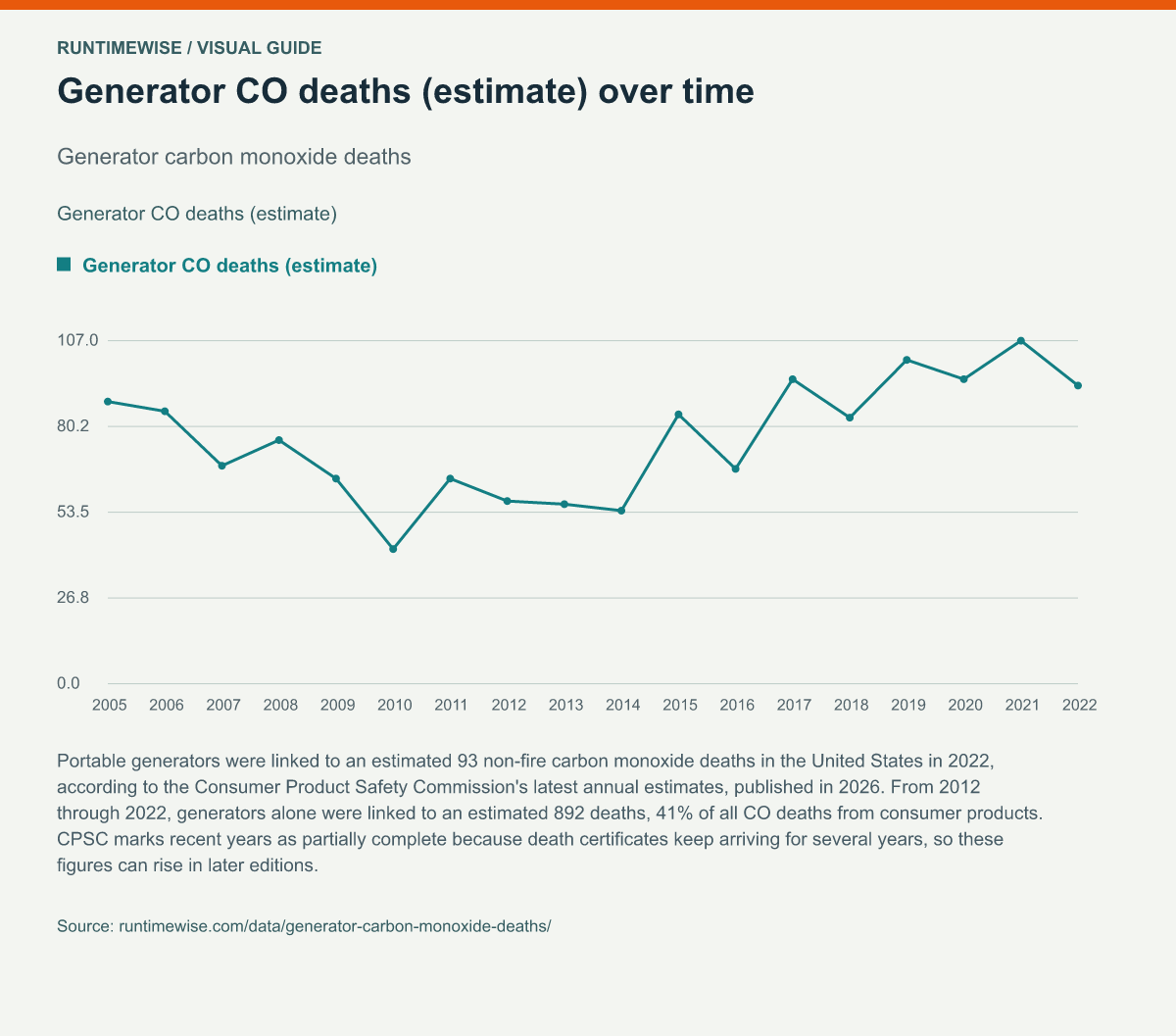
| Year | Generator CO deaths (estimate) | All consumer-product CO deaths (estimate) | Generator share |
|---|---|---|---|
| 2022 | 93 | 274 | 34% |
| 2021 | 107 | 216 | 50% |
| 2020 | 95 | 223 | 43% |
| 2019 | 101 | 254 | 40% |
| 2018 | 83 | 209 | 40% |
| 2017 | 95 | 188 | 51% |
| 2016 | 67 | 178 | 38% |
| 2015 | 84 | 172 | 49% |
| 2014 | 54 | 164 | 33% |
| 2013 | 56 | 146 | 38% |
| 2012 | 57 | 137 | 42% |
| 2011 | 64 | 163 | 39% |
| 2010 | 42 | 159 | 26% |
| 2009 | 64 | 148 | 43% |
| 2008 | 76 | 178 | 43% |
| 2007 | 68 | 186 | 37% |
| 2006 | 85 | 180 | 47% |
| 2005 | 88 | 190 | 46% |
Where do generator carbon monoxide deaths happen?
Most deaths happen at home. Of 789 generator-related CO deaths reported to CPSC from 2012 to 2022, 553 (70%) were in houses, apartments or mobile homes. In 73% of those home deaths, the generator was running inside: in the living space, a basement or an attached garage. Even placing a generator outdoors isn't enough if it is near a window, door or vent; 28 home deaths involved a generator outside the house.
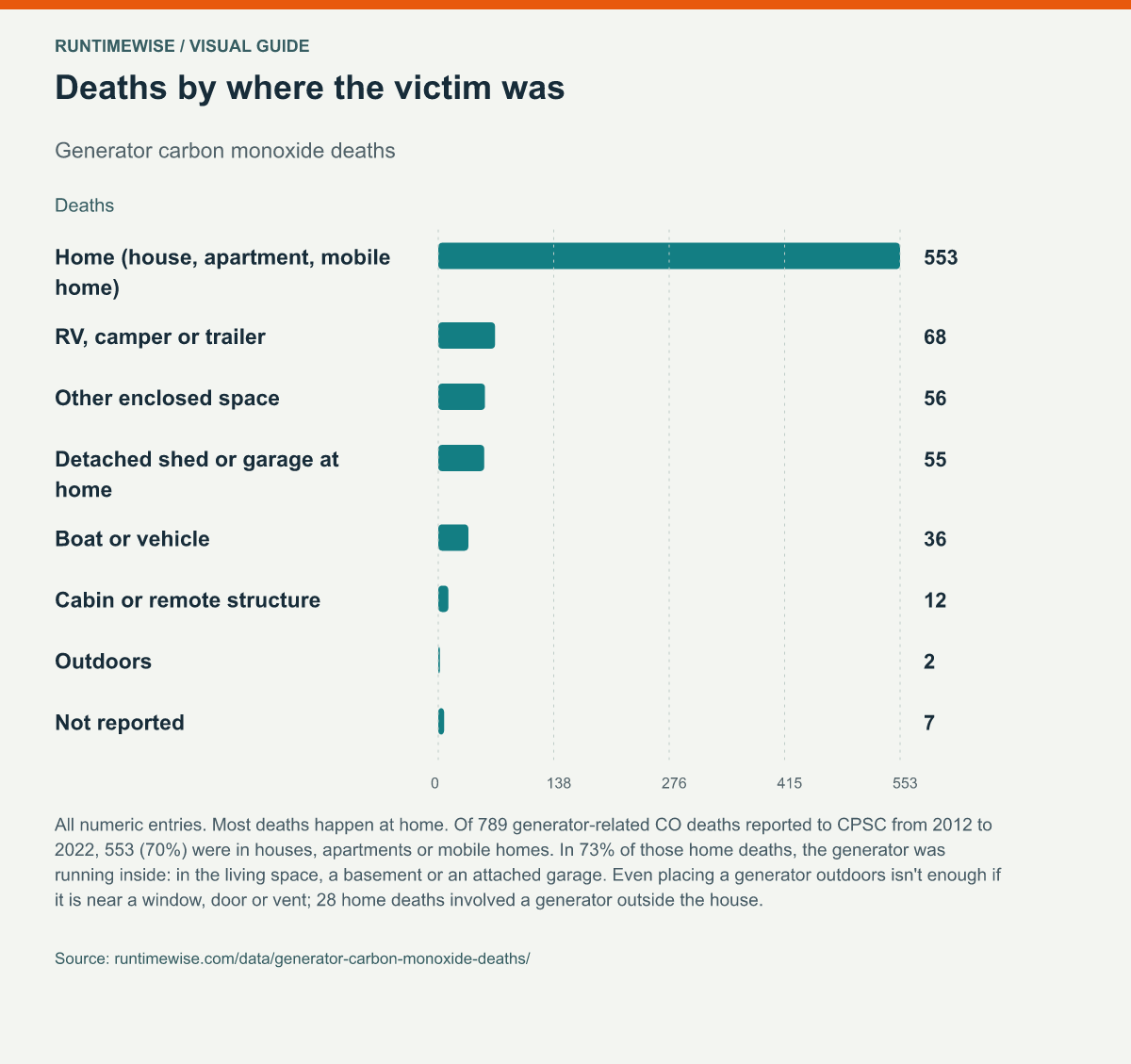
| Where the victim was | Deaths | Share |
|---|---|---|
| Home (house, apartment, mobile home) | 553 | 70% |
| RV, camper or trailer | 68 | 9% |
| Other enclosed space | 56 | 7% |
| Detached shed or garage at home | 55 | 7% |
| Boat or vehicle | 36 | 5% |
| Cabin or remote structure | 12 | 2% |
| Outdoors | 2 | <1% |
| Not reported | 7 | <1% |
| Where the generator was (home deaths) | Deaths | Share |
|---|---|---|
| Living space | 221 | 40% |
| Basement or crawlspace | 99 | 18% |
| Attached garage or enclosed carport | 99 | 18% |
| Inside, room not known | 58 | 10% |
| Closet, hallway, laundry or utility room | 25 | 5% |
| Outdoors, near the house | 28 | 5% |
| Inside the building, outside the apartment | 3 | 1% |
| Unknown | 22 | 4% |
Why were people running generators when they died?
Power outages are a leading reason, but not the only one. Outages account for 139 deaths, the same number as generators powering a camper, cabin, boat or shed. A utility shutoff, such as a disconnection for an unpaid bill, accounts for another 118. Where an outage was involved and its cause was known, weather was behind 85% of the fatal incidents. Hurricanes and tropical storms led (55 deaths), followed by ice and snow storms (38).
| Reason for running the generator | Deaths | Share |
|---|---|---|
| Power outage | 139 | 18% |
| Power at a camper, cabin, boat or shed | 139 | 18% |
| Utility shut off (for example, unpaid bill) | 118 | 15% |
| New home or renovation, no power yet | 82 | 10% |
| Home normally without electricity | 72 | 9% |
| Shed or garage without electricity | 8 | 1% |
| Storm preparation or testing | 3 | 0% |
| Other | 15 | 2% |
| Unknown | 213 | 27% |
| Cause of the power outage | Deaths |
|---|---|
| Hurricane or tropical storm | 55 |
| Ice or snow storm | 38 |
| Wind storm | 13 |
| Thunderstorm, rain or flooding | 5 |
| Storm, type not stated | 12 |
| Other or unknown cause | 16 |
Who dies from generator carbon monoxide poisoning?
78% of generator CO victims from 2012 to 2022 were male, and 41% were aged 45 to 64. 40 children under 15 died. Most deaths came in the colder months: 44% in November to February, 32% in March, April, September and October, and 23% in May to August. Where CPSC knew whether a CO alarm was present, 132 of 159 victims (83%) had none.
| Age | Deaths | Share |
|---|---|---|
| Under 5 | 7 | 1% |
| 5–14 | 33 | 4% |
| 15–24 | 62 | 8% |
| 25–44 | 236 | 30% |
| 45–64 | 321 | 41% |
| 65 and over | 129 | 16% |
What is being done about generator carbon monoxide?
CPSC proposed a mandatory safety standard for portable generators in 2023 that would limit CO emissions and require automatic shutoff. The agency projects it would prevent 2,148 deaths and 126,377 injuries over 30 years, about 72 deaths a year. In CPSC's simulation of 511 known deaths, generators meeting the UL 2201 emissions standard would have averted about 99.99%, and the industry's voluntary G300 shutoff alone about 87%. When we checked in October 2026 the rule was still listed as pending a final decision.
How can you run backup power without carbon monoxide risk?
Ready.gov's advice is to run fuel generators only outdoors, at least 20 feet from windows, doors and vents, and to fit battery CO alarms on every level of the home. Battery power stations produce no exhaust and are safe to use indoors, which is why many households use one for the fridge, lights, Wi-Fi and medical devices, keeping any generator well away from the house. For the battery size an outage needs, see our outage statistics by state.
Can you download and reuse this data?
Yes. The main table is available as a CSV file (18 rows), and every chart on this page opens as a full-size image when you select it. Our compilation, calculations and charts are licensed CC BY 4.0: reuse them in articles, reports, slides or lessons, as long as you credit RuntimeWise and link to this page. The underlying data belongs to the sources listed below, so please credit them too.
How should you cite this page?
Copy one of these. A link to this page is the only credit we ask for.
Citation
RuntimeWise (2026). Generator Carbon Monoxide Deaths: CPSC Statistics. Retrieved October 22, 2026, from https://www.runtimewise.com/data/generator-carbon-monoxide-deaths/HTML link
<a href="https://www.runtimewise.com/data/generator-carbon-monoxide-deaths/">Generator Carbon Monoxide Deaths: CPSC Statistics</a> (RuntimeWise)How was this data compiled?
Yearly estimates come from CPSC's "Non-Fire Carbon Monoxide Deaths Associated with the Use of Consumer Products: 2022 Annual Estimates (J. Topping, CPSC, May 2026)", Appendix B: Table B.2 for generators and Table B.1 for all consumer products. Breakdowns come from CPSC's "Fatal Incidents Associated with Non-Fire Carbon Monoxide Poisoning from Engine-Driven Generators and Other Engine-Driven Tools, 2012-2022 (K. F. O'Connor, CPSC, July 2023)", which uses reported cases. The rulemaking figures are from the Safety Standard for Portable Generators, Supplemental Notice of Proposed Rulemaking, 88 FR 24346 (April 20, 2023). All values are copied from those documents, and nothing is estimated by us except the generator share column.
- Estimates and reported counts measure different things. A national estimate covers deaths where the generator was the only product involved. A reported count is a minimum and includes incidents involving a generator plus another product. The breakdowns therefore total 789, not 892.
- CPSC labels 2018–2022 as partially complete and excludes 2023 onward from estimates until reporting is complete.
- Limits: CPSC has no state-level generator figures. Reasons, alarm status and generator location are unknown in many cases, so the shares above are of known cases where stated.
Sources
- Non-Fire Carbon Monoxide Deaths Associated with the Use of Consumer Products: 2022 Annual Estimates (J. Topping, CPSC, May 2026)
- Fatal Incidents Associated with Non-Fire Carbon Monoxide Poisoning from Engine-Driven Generators and Other Engine-Driven Tools, 2012-2022 (K. F. O'Connor, CPSC, July 2023)
- Safety Standard for Portable Generators, Supplemental Notice of Proposed Rulemaking, 88 FR 24346 (April 20, 2023)
- Ready.gov: power outages