Appliance wattage chart: running and starting watts
While running, a household appliance draws anything from about 6 W (a CPAP without heated humidifier) to about 1,800 W (an RV rooftop air conditioner); heaters, kettles and hair dryers sit near 1,500 W. Motor appliances such as fridges, pumps and air conditioners need a short start-up spike of two to 13 times their running watts. This chart lists 53 appliances, each with its source.
Key findings
We list 53 appliances with their running watts and, for motor loads, their start-up (surge) watts. Each figure comes from a manufacturer spec sheet, ENERGY STAR data, the Department of Energy or a generator maker's wattage guide.
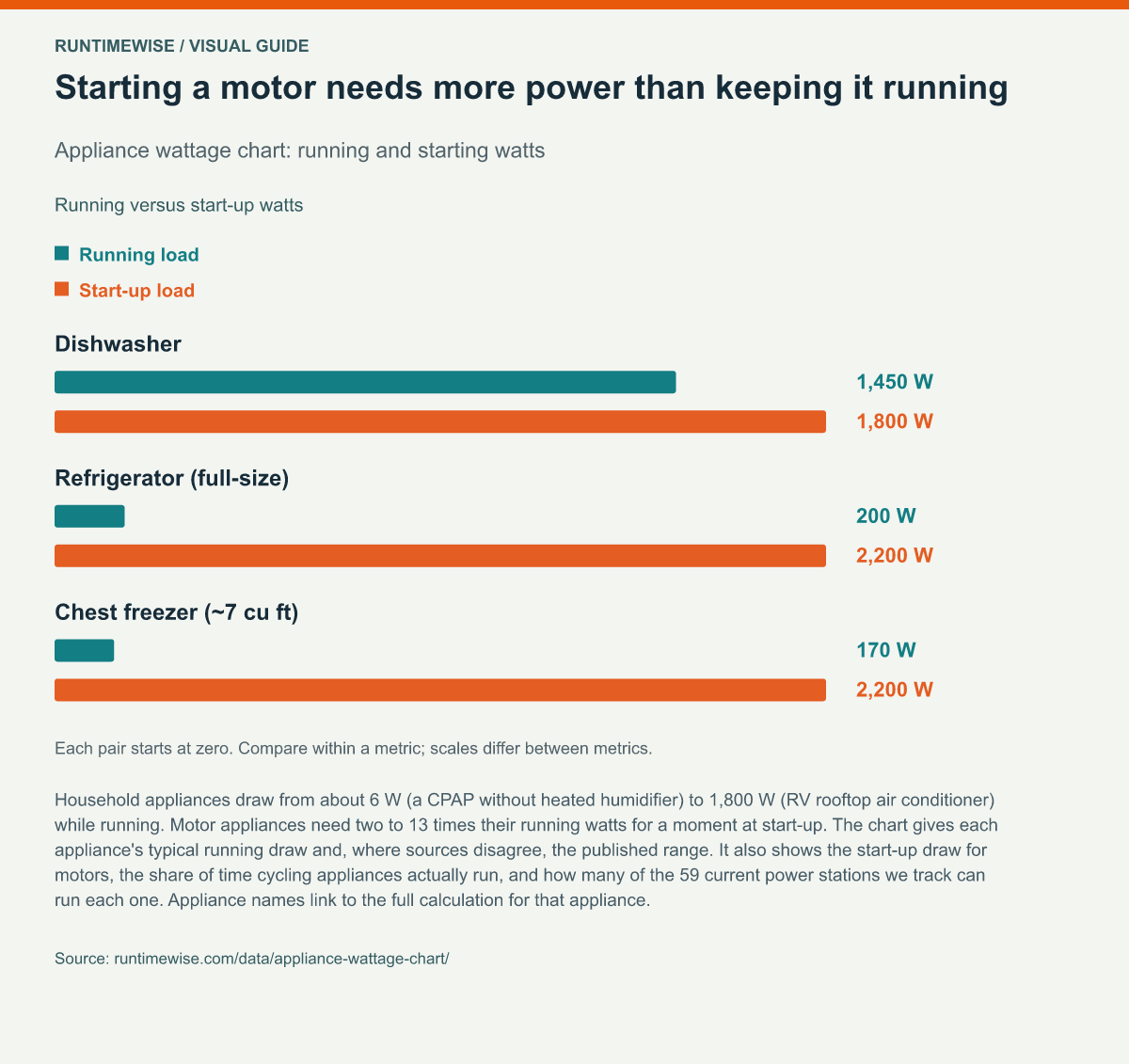
Motors need far more power for a moment at start-up. A chest freezer draws about 2,200 W to start against 170 W running (12.9×).
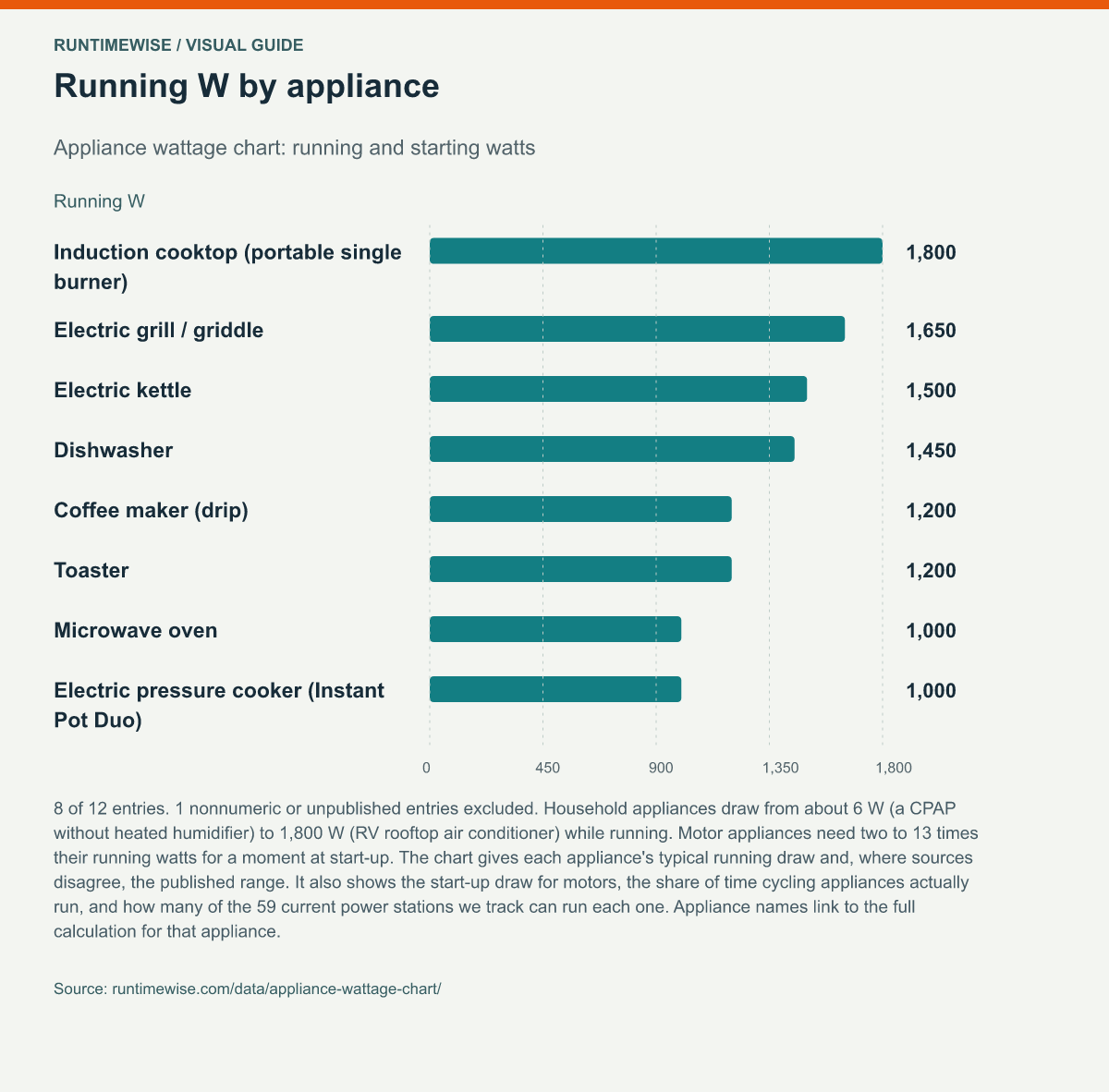
The biggest continuous loads are RV rooftop air conditioner (1,800 W), induction cooktop (1,800 W) and electric grill / griddle (1,650 W).
12 of the 53 appliances draw 100 W or less, so a 1,000 Wh battery runs any one of them for at least 8.5 hours.
The median current portable power station (2,000 W continuous, 3,600 W surge) can run 51 of these appliances, start-up surge included.
How many watts do household appliances use?
Household appliances draw from about 6 W (a CPAP without heated humidifier) to 1,800 W (RV rooftop air conditioner) while running. Motor appliances need two to 13 times their running watts for a moment at start-up. The chart gives each appliance's typical running draw and, where sources disagree, the published range. It also shows the start-up draw for motors, the share of time cycling appliances actually run, and how many of the 59 current power stations we track can run each one. Appliance names link to the full calculation for that appliance.
Kitchen
| Appliance | Running W | Range W | Start-up W | Share of time on | On 1,000 Wh | Stations that run it | Source |
|---|---|---|---|---|---|---|---|
| Induction cooktop (portable single burner) | 1,800 | 100–1,800 | — | — | — | 39 of 59 | concordlibrary.org |
| Electric grill / griddle | 1,650 | — | — | — | — | 39 of 59 | help.championpowerequipment.com +1 |
| Electric kettle | 1,500 | — | — | — | — | 43 of 59 | web.archive.org |
| Dishwasher | 1,450 | 1,200–2,400 | 1,800 | — | — | 42 of 59 | pubs.ext.vt.edu +1 |
| Coffee maker (drip) | 1,200 | 900–1,750 | — | — | — | 43 of 59 | dam.generac.com +3 |
| Toaster | 1,200 | 800–1,650 | — | — | — | 43 of 59 | dam.generac.com +2 |
| Microwave oven | 1,000 | 625–1,500 | — | — | 0.8 h | 44 of 59 | help.championpowerequipment.com +4 |
| Electric pressure cooker (Instant Pot Duo) | 1,000 | — | — | — | 0.8 h | 44 of 59 | williams-sonoma.com |
| Blender | 1,000 | 300–1,000 | — | — | 0.8 h | 44 of 59 | help.championpowerequipment.com +1 |
| Slow cooker | 250 | 200–250 | — | — | 3.4 h | 58 of 59 | help.championpowerequipment.com +1 |
| Refrigerator (full-size) | 200 | 200–725 | 2,200 | 33% | 13 h | 42 of 59 | direct.powerequipment.honda.com +5 |
| Chest freezer (~7 cu ft) | 170 | 170–600 | 2,200 | 19% | 26 h | 42 of 59 | frigidaire.bynder.com +2 |
| Mini fridge (compact, ~3.2 cu ft) | — | — | — | — | — | 0 of 59 | frigidaire.bynder.com +1 |
Medical
| Appliance | Running W | Range W | Start-up W | Share of time on | On 1,000 Wh | Stations that run it | Source |
|---|---|---|---|---|---|---|---|
| Oxygen concentrator (home, Philips EverFlo 5 L/min) | 350 | — | — | — | 2.4 h | 54 of 59 | philips.com.au |
| CPAP with heated humidifier (ResMed AirSense 11) | 56 | — | — | — | 15 h | 59 of 59 | nihstrokenet.uc.edu |
| CPAP without heated humidifier (ResMed AirMini travel CPAP) | 6 | — | — | — | 5.6 days | 59 of 59 | ap.resmed.com |
Heating and cooling
| Appliance | Running W | Range W | Start-up W | Share of time on | On 1,000 Wh | Stations that run it | Source |
|---|---|---|---|---|---|---|---|
| Space heater (portable electric) | 1,500 | 750–1,500 | — | — | — | 43 of 59 | pubs.ext.vt.edu |
| Portable air conditioner (10,000 BTU ASHRAE) | 1,160 | — | — | — | — | 43 of 59 | assets.ajmadison.com |
| Dehumidifier | 785 | 650–785 | 800 | — | 1.1 h | 46 of 59 | pubs.ext.vt.edu +1 |
| Window air conditioner | 720 | 450–1,800 | 2,800 | — | 1.2 h | 39 of 59 | static.pcrichard.com +3 |
| Box / window fan | 200 | 55–250 | — | — | 4.2 h | 59 of 59 | pubs.ext.vt.edu +1 |
| Ceiling fan | 175 | 65–175 | — | — | 4.9 h | 59 of 59 | pubs.ext.vt.edu |
| Electric blanket | 100 | 60–100 | — | — | 8.5 h | 59 of 59 | pubs.ext.vt.edu +1 |
RV and camping
| Appliance | Running W | Range W | Start-up W | Share of time on | On 1,000 Wh | Stations that run it | Source |
|---|---|---|---|---|---|---|---|
| RV rooftop air conditioner (15,000 BTU) | 1,800 | — | — | — | — | 39 of 59 | dam.generac.com |
| RV / 12V compressor fridge (portable, e.g. Dometic CFX) | 48 | — | — | 22% | 3.4 days | 59 of 59 | dometic.com |
Personal care
| Appliance | Running W | Range W | Start-up W | Share of time on | On 1,000 Wh | Stations that run it | Source |
|---|---|---|---|---|---|---|---|
| Hair dryer | 1,500 | 300–1,875 | — | — | — | 43 of 59 | pubs.ext.vt.edu +2 |
Household
| Appliance | Running W | Range W | Start-up W | Share of time on | On 1,000 Wh | Stations that run it | Source |
|---|---|---|---|---|---|---|---|
| Vacuum cleaner | 1,440 | 800–1,440 | 1,500 | — | — | 43 of 59 | pubs.ext.vt.edu +1 |
| Clothes iron | 1,200 | 1,000–1,800 | — | — | — | 43 of 59 | pubs.ext.vt.edu +1 |
| Washing machine (clothes washer) | 1,150 | 350–1,150 | 2,300 | — | — | 42 of 59 | help.championpowerequipment.com +2 |
| Garage door opener | 725 | 550–725 | 1,400 | — | 1.2 h | 44 of 59 | web.archive.org |
Home systems
| Appliance | Running W | Range W | Start-up W | Share of time on | On 1,000 Wh | Stations that run it | Source |
|---|---|---|---|---|---|---|---|
| Well pump | 1,000 | 250–1,100 | 2,100 | — | 0.8 h | 42 of 59 | help.championpowerequipment.com +2 |
| Sump pump | 800 | 750–1,000 | 2,100 | — | 1.1 h | 42 of 59 | help.championpowerequipment.com +2 |
| Furnace blower fan (gas/oil furnace) | 600 | 500–1,200 | 1,600 | — | 1.4 h | 43 of 59 | direct.powerequipment.honda.com +3 |
Electronics
| Appliance | Running W | Range W | Start-up W | Share of time on | On 1,000 Wh | Stations that run it | Source |
|---|---|---|---|---|---|---|---|
| Desktop computer + monitor | 270 | 150–400 | — | — | 3.1 h | 58 of 59 | pubs.ext.vt.edu +2 |
| Game console | 150 | — | — | — | 5.7 h | 59 of 59 | help.championpowerequipment.com |
| TV (LED/LCD flat screen) | 120 | 120–150 | — | — | 7.1 h | 59 of 59 | dam.generac.com +2 |
| Starlink Standard kit | 100 | 75–100 | — | — | 8.5 h | 59 of 59 | puc.bz |
| Laptop | 50 | — | — | — | 17 h | 59 of 59 | pubs.ext.vt.edu +2 |
| Starlink Mini | 25 | — | — | — | 34 h | 59 of 59 | puc.bz |
| Wi-Fi router / modem | 20 | — | — | — | 42 h | 59 of 59 | help.championpowerequipment.com +1 |
| Tablet | 20 | — | — | — | 42 h | 59 of 59 | dam.generac.com |
| Phone charger | 10 | — | — | — | 3.5 days | 59 of 59 | dam.generac.com |
Lighting
| Appliance | Running W | Range W | Start-up W | Share of time on | On 1,000 Wh | Stations that run it | Source |
|---|---|---|---|---|---|---|---|
| LED light bulb (60 W-equivalent, 800 lumens) | 9 | — | — | — | 3.9 days | 59 of 59 | feit.com |
Power tools
| Appliance | Running W | Range W | Start-up W | Share of time on | On 1,000 Wh | Stations that run it | Source |
|---|---|---|---|---|---|---|---|
| Air compressor (1 hp) | 1,500 | 1,000–1,600 | 4,500 | — | — | 18 of 59 | web.archive.org +2 |
| Circular saw | 1,400 | 800–1,800 | 2,300 | — | — | 42 of 59 | web.archive.org +2 |
| Electric chainsaw | 1,200 | 900–1,200 | 2,400 | — | — | 42 of 59 | help.championpowerequipment.com +1 |
| Electric pressure washer | 1,200 | — | 2,400 | — | — | 42 of 59 | help.championpowerequipment.com |
| Wet/dry shop vac | 900 | 900–1,300 | 1,300 | — | 0.9 h | 43 of 59 | dam.generac.com +1 |
| Corded drill | 600 | 350–600 | 900 | — | 1.4 h | 48 of 59 | help.championpowerequipment.com +2 |
| Cordless tool battery charger (Li-ion) | 360 | — | — | — | 2.4 h | 53 of 59 | dam.generac.com |
E-bikes and EVs
| Appliance | Running W | Range W | Start-up W | Share of time on | On 1,000 Wh | Stations that run it | Source |
|---|---|---|---|---|---|---|---|
| EV charging (Level 1, 120 V) | 1,440 | 1,300–1,920 | — | — | — | 43 of 59 | digitalassets-shop.tesla.com +1 |
| E-bike battery charger | 144 | 72–432 | — | — | 5.9 h | 59 of 59 | bosch-ebike.com +2 |
| Electric scooter charger | 70 | 36–122 | — | — | 12 h | 59 of 59 | store.segway.com +3 |
What is the difference between running watts and starting watts?
Running watts are what an appliance draws once it is going, and starting (surge) watts are the brief spike a motor or compressor needs to get moving. A full-size refrigerator, for example, is listed at 200 W running and up to 2,200 W at start-up. Resistive loads such as kettles, toasters and heaters have no meaningful start-up spike, because they draw the same power from the first second. When you size a generator or power station, make sure its continuous rating covers the running watts of everything you will use at once. Its surge rating must cover the largest single start-up spike.
Which appliances use the most electricity?
By instantaneous draw, anything that makes heat dominates. Space heaters, kettles, hair dryers, irons, toasters and induction burners sit between about 1,000 and 1,800 W, close to what a standard 15 A, 120 V outlet can supply. Daily energy depends on hours of use. A fridge draws only 200 W but cycles around the clock, so it uses about 1.6 kWh a day. A 1,500 W kettle used for ten minutes uses about 0.25 kWh.
How long will a battery run each appliance?
Runtime is battery watt-hours × inverter efficiency ÷ running watts. On a 1,000 Wh power station with an 85% efficient inverter, a 10 W phone charger runs about 85 hours and a 120 W TV about 7.1 hours. A 1,000 W microwave runs about 51 minutes. The "On 1,000 Wh" column applies the share of time on wherever a source gives one. For your own mix of appliances, use the runtime calculator.
Can you download and reuse this data?
Yes. The main table is available as a CSV file (53 rows), and every chart on this page opens as a full-size image when you select it. Our compilation, calculations and charts are licensed CC BY 4.0: reuse them in articles, reports, slides or lessons, as long as you credit RuntimeWise and link to this page. The underlying data belongs to the sources listed below, so please credit them too.
How should you cite this page?
Copy one of these. A link to this page is the only credit we ask for.
Citation
RuntimeWise (2026). Appliance Wattage Chart: Running and Starting Watts. Retrieved October 22, 2026, from https://www.runtimewise.com/data/appliance-wattage-chart/HTML link
<a href="https://www.runtimewise.com/data/appliance-wattage-chart/">Appliance Wattage Chart: Running and Starting Watts</a> (RuntimeWise)How was this data compiled?
Each appliance figure comes from a named source, linked in its table row. Sources include manufacturer spec sheets and manuals (ResMed, Philips, Frigidaire, Panasonic, Dometic, Zoeller and Franklin Electric), ENERGY STAR certified-product data, the U.S. Department of Energy, university extension services, and the wattage guides generator makers publish (Honda, Champion and Generac). Where sources disagree we show the range and use a typical figure in calculations. A "+n" after a source counts the extra sources we checked.
- "Share of time on" is how often a cycling appliance's compressor or element runs. We use it only where a source states it, such as DOE's guidance to divide a fridge's plugged-in time by three.
- "Stations that run it" counts current models whose continuous output covers the running watts and whose surge rating covers the start-up watts. It is a calculation from published specs, not a test.
- Limits: your own appliance may differ. The label on the appliance or its manual gives the best figure for it, and a plug-in watt meter is better still. Start-up spikes vary with temperature, voltage and how long the motor has been off.
Sources
- U.S. Department of Energy, Energy Saver: estimating appliance and home electronic energy use
- Honda Power Equipment: how much power do you need?
- Champion Power Equipment wattage reference chart
- ENERGY STAR product finder
- Manufacturer sources for each appliance: linked in each table row and in the CSV