How long do portable power stations last?
Most current portable power stations are rated for 4,000 full charge cycles (the median of the 52 models that publish a rating), which is about 11 years if you empty and refill it every day, and far longer if you use it on weekends or only in outages. Ratings run from 800 to 6,000 cycles, and heat and deep discharges shorten real life.
How do cycle ratings differ by battery chemistry?
The chemistry sets the ceiling. Across current models with a published rating:
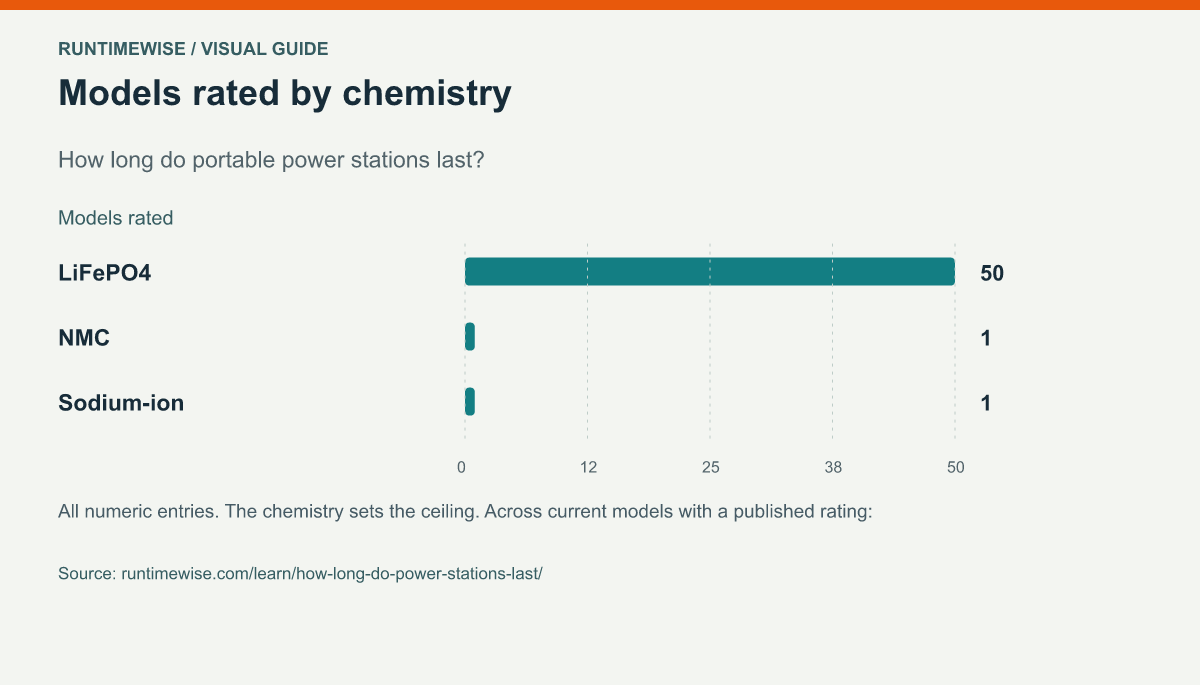
| Chemistry | Models rated | Lowest rating | Median rating | Highest rating |
|---|---|---|---|---|
| LiFePO4 | 50 | 3,000 | 4,000 | 6,000 |
| NMC | 1 | 800 | 800 | 800 |
| Sodium-ion | 1 | 4,000 | 4,000 | 4,000 |
7 of 59 current models don't publish a cycle rating at all. Those models show "Not published" on their pages, and we never estimate the figure.
Which current models carry the highest cycle ratings?
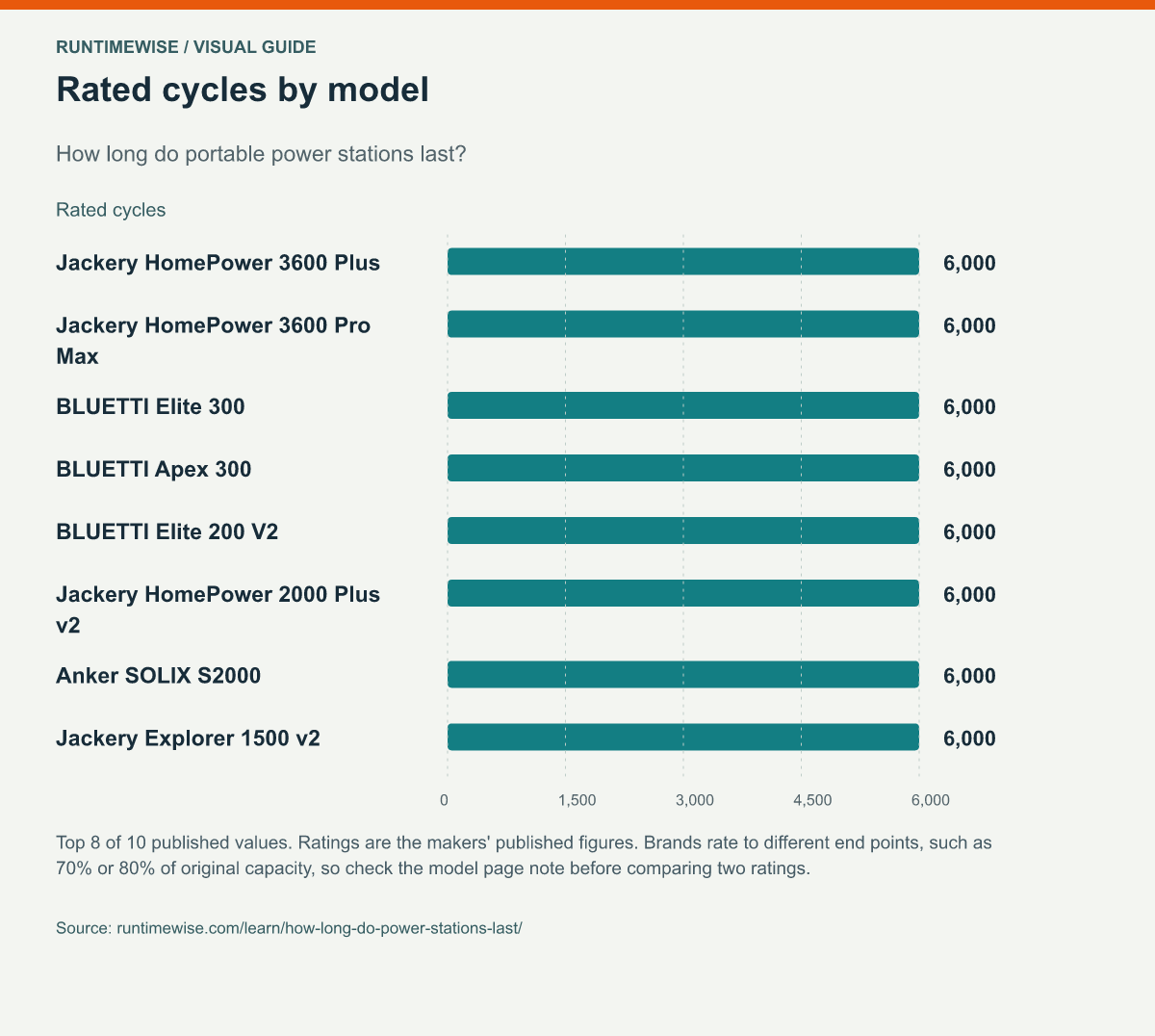
| Model | Rated cycles | Capacity | Years at 1 cycle a day |
|---|---|---|---|
| Jackery HomePower 3600 Plus | 6,000 | 3,584 Wh | 16.4 |
| Jackery HomePower 3600 Pro Max | 6,000 | 3,584 Wh | 16.4 |
| BLUETTI Elite 300 | 6,000 | 3,014 Wh | 16.4 |
| BLUETTI Apex 300 | 6,000 | 2,765 Wh | 16.4 |
| BLUETTI Elite 200 V2 | 6,000 | 2,074 Wh | 16.4 |
| Jackery HomePower 2000 Plus v2 | 6,000 | 2,048 Wh | 16.4 |
| Anker SOLIX S2000 | 6,000 | 2,010 Wh | 16.4 |
| Jackery Explorer 1500 v2 | 6,000 | 1,536 Wh | 16.4 |
| Jackery HomePower 1000 v2 | 6,000 | 1,024 Wh | 16.4 |
| Jackery HomePower 1000 Plus v2 | 6,000 | 1,024 Wh | 16.4 |
Ratings are the makers' published figures. Brands rate to different end points, such as 70% or 80% of original capacity, so check the model page note before comparing two ratings.
What does a cycle rating actually promise?
A cycle rating is the number of full charge-and-discharge cycles a battery can deliver before its capacity falls to a stated share of what it held new. It does not mean the station stops working at that count. It means the battery holds less, so every runtime on the page gets shorter in proportion.
One cycle is one full battery's worth of energy, not one plug-in. Draining a station from 100% to 50% twice adds up to one cycle. That is why light, partial use stretches the calendar life of a station far beyond what the headline number suggests.
Of the 59 current models we track, 52 publish a cycle rating and 7 do not. Published ratings run from 800 to 6,000 cycles, with a median of 4,000. The highest ratings belong to BLUETTI Apex 300 (6,000), Anker SOLIX S2000 (6,000), Jackery Explorer 1500 v2 (6,000), Jackery HomePower 1000 v2 (6,000) and Jackery HomePower 1000 Plus v2 (6,000).
How many years is that for the way you use it?
Divide the rating by how many full cycles you run in a year. The table converts every rating that current models publish into years at two usage patterns, plus the total energy a 1,024 Wh station like the EcoFlow DELTA 3 would deliver over that many cycles.
| Rated cycles | Models | Years at 1 cycle a day | Years at 2 cycles a week | Lifetime kWh for a 1,024 Wh station |
|---|---|---|---|---|
| 6,000 | 11 | 16.4 | 58 | 6,144 |
| 4,000 | 25 | 11.0 | 38 | 4,096 |
| 3,500 | 3 | 9.6 | 34 | 3,584 |
| 3,000 | 12 | 8.2 | 29 | 3,072 |
| 800 | 1 | 2.2 | 8 | 819 |
Worked example: at the median rating of 4,000 cycles, a station emptied and refilled every day reaches its rating in about 11.0 years. Used for two full cycles a week, such as weekend camping, the same rating stretches to about 38 years. At that point age, not cycles, is what wears the cells, so the cycle count stops being the limit.
The lowest rating among current models works out to about 2.2 years of daily cycling. That model is the exception: Jackery Explorer 300 (800 cycles) uses NMC cells, which carry far lower ratings than LiFePO4.
What wears a power station battery out faster?
Three things shorten real life compared with the rating: heat, deep discharges and the cell chemistry itself. The rating is set in controlled conditions, and your garage or car is not one.
Heat
Heat speeds up wear in LiFePO4 cells. In Sandia National Laboratories' multi-year cell tests, the rate at which LiFePO4 cells lost capacity rose as the test temperature went up between 15 and 35 °C, while NMC cells behaved the opposite way in that range. (Degradation of Commercial Lithium-Ion Cells as a Function of Chemistry and Cycling Conditions (Preger et al., J. Electrochem. Soc. 167 120532), Sandia National Laboratories / The Electrochemical Society, 2020) The practical rule is simple: don't store or charge a station in a hot car, an attic or a sunny shed if you can avoid it.
Deep discharges
Running a battery all the way down does more harm to some chemistries than others. The same Sandia work found NMC and NCA cells showed a sharper jump in capacity loss when moved from partial to full depth of discharge than LiFePO4 cells did. (Degradation of Commercial Lithium-Ion Cells as a Function of Chemistry and Cycling Conditions (Preger et al., J. Electrochem. Soc. 167 120532), Sandia National Laboratories / The Electrochemical Society, 2020) If you own an NMC model, keeping a reserve rather than running it flat helps more than it does for LiFePO4.
Chemistry
LiFePO4 cells simply last more cycles. Sandia's lab cells lasted far longer before reaching 80% capacity than the NMC cells tested alongside them, which matches the gap between the ratings brands publish. (Degradation of Commercial Lithium-Ion Cells as a Function of Chemistry and Cycling Conditions (Preger et al., J. Electrochem. Soc. 167 120532), Sandia National Laboratories / The Electrochemical Society, 2020) For a deeper comparison of the three chemistries in current models, see LiFePO4 vs NMC vs sodium-ion.
How should you store a power station between uses?
Follow the storage instructions in your model's manual. Makers state a storage charge level and how often to top the battery up during long storage, and those figures differ by model, so the manual is the authority.
- Keep it cool and dry. Heat is the clearest driver of LiFePO4 wear in the research above.
- Don't leave it empty. A battery keeps losing a little charge in storage, and one left drained for months can fall low enough that it struggles or refuses to recharge.
- Top it up on a schedule. Set a calendar reminder at the interval your manual gives, and check the charge before storm season.
- Keep it plugged in only if the maker allows it. Many stations are designed to sit on the charger as a backup, but the manual says whether yours is.
If the station is your home backup, a quick check every few months also tells you it will be ready. See the best power stations for home backup for models built to sit plugged in.
Which model gives the most lifetime energy for the money?
Divide the list price by the total energy the battery should deliver over its rated cycles, and you get a cost per rated kilowatt-hour. It rewards a station that combines a high rating, a large battery and a fair price.
| Model | Rated cycles | List price | Cents per rated kWh | Check price |
|---|---|---|---|---|
| BLUETTI Elite 300Amazon | 6,000 | $1,199 | 6.6 | On Amazon |
| BLUETTI Elite 100 miniAmazon | 6,000 | $429 | 7.1 | On Amazon |
| BLUETTI Elite 200 V2Amazon | 6,000 | $899 | 7.2 | On Amazon |
| Anker SOLIX S2000Amazon | 6,000 | $999.99 | 8.3 | On Amazon |
| Jackery HomePower 3600 PlusAmazon | 6,000 | $1,899 | 8.8 | On Amazon |
| Jackery HomePower 2000 Plus v2Amazon | 6,000 | $1,199 | 9.8 | On Amazon |
| Jackery HomePower 3600 Pro MaxAmazon | 6,000 | $2,099 | 9.8 | On Amazon |
| BLUETTI Apex 300Amazon | 6,000 | $1,699 | 10.2 | On Amazon |
The BLUETTI Elite 300 comes out lowest at about 7 cents per rated kWh; the median current model is about 19 cents. Treat these as ceilings on value, since few owners use every rated cycle before the station is replaced for other reasons.
List prices from official pages on the date checked; sales change them often. Rated kWh = capacity × rated cycles.
How do you tell when a battery is wearing out?
The clearest sign is runtime. If a load you know well, such as your router or fridge, now runs noticeably shorter from a full charge than it did when the station was new, the battery holds less than it did.
Many stations show the battery's health or remaining capacity in their app or on screen; where yours does, compare it once a year. To estimate how much runtime you have left, enter your loads and the station's original capacity in the runtime calculator, then scale the result by the share of capacity the battery still holds.
A station at 80% of its original capacity still runs everything it ran before, just for about a fifth less time. Whether that matters depends on how close to the limit you were sizing it. If you sized with headroom, as how to size a power station recommends, a worn battery may still do the job for years.
Does a power station lose capacity just sitting unused?
Yes, slowly. Lithium cells age with time as well as with use, so a station that spends years in a closet still holds somewhat less than it did new, even with few cycles on the counter. Cycle ratings don't capture this, which is why the years in the table above are an upper bound rather than a forecast.
Calendar aging is gentlest when the battery is kept cool and at the storage charge level the manual gives. It is harshest when a battery sits full in a hot place for long periods. For a backup station that might sit unused for most of the year, that makes storage conditions more important than the cycle rating.
This is also why an emergency station deserves an occasional real test. Run a known load, such as your router, for an hour or two a couple of times a year, then recharge it. You confirm the station works, you see whether runtime has slipped, and you keep the battery from sitting at one charge level indefinitely.
Can you replace the battery when it wears out?
Check with the maker before you buy if this matters to you. Our spec data covers capacity, output and cycle ratings, not battery service, and makers differ in whether they offer battery replacement or repair.
Add-on batteries are a different thing. On an expandable station, an extra battery adds capacity alongside the built-in one; it does not replace a worn internal battery, although the combined bank still runs your loads for longer. If long service life is the priority, a model with a high cycle rating and expansion options gives you the most room to adapt as your needs and the battery change.
When a station does reach the end of its useful life, don't put it in household trash. Lithium batteries belong in a battery recycling or household hazardous waste program; your local waste authority or the retailer can tell you where to take it.
What should you look for if you want a station to last?
- LiFePO4 cells and a high published rating. Check the rating's end point in the model notes, since brands rate to different capacity levels.
- Enough capacity that you rarely run it flat. A bigger battery cycles less deeply for the same daily use.
- Expandability. An add-on battery spreads the load over more cells, and a station built for off-grid use is designed to cycle every day.
- Solar input that refills it without stress. See what limits solar charging speed.
- The warranty on the brand's own page. We don't track warranty terms, so read them before you buy.
For a low-cost entry with long-life cells, the best cheap LiFePO4 power stations list filters on chemistry and price together.