Jackery vs Anker SOLIX: which power station brand is better?
Jackery sells 15 current models from 256 to 5,040 Wh at $249–$3,499 list; Anker SOLIX sells 9 from 288 to 3,840 Wh at $329.99–$2,699.99. Anker SOLIX's median model gives more watt-hours per list dollar (1.71 vs 1.62). The median Jackery model weighs 32 lb against 41.7 lb for Anker SOLIX.
How do Jackery and Anker SOLIX compare spec by spec?
Comparing the median current model from each brand, Jackery leads on surge, rated cycles, weight and UPS switchover and Anker SOLIX leads on capacity, AC output, solar input and Wh per list dollar. Differences under 5% count as a tie.
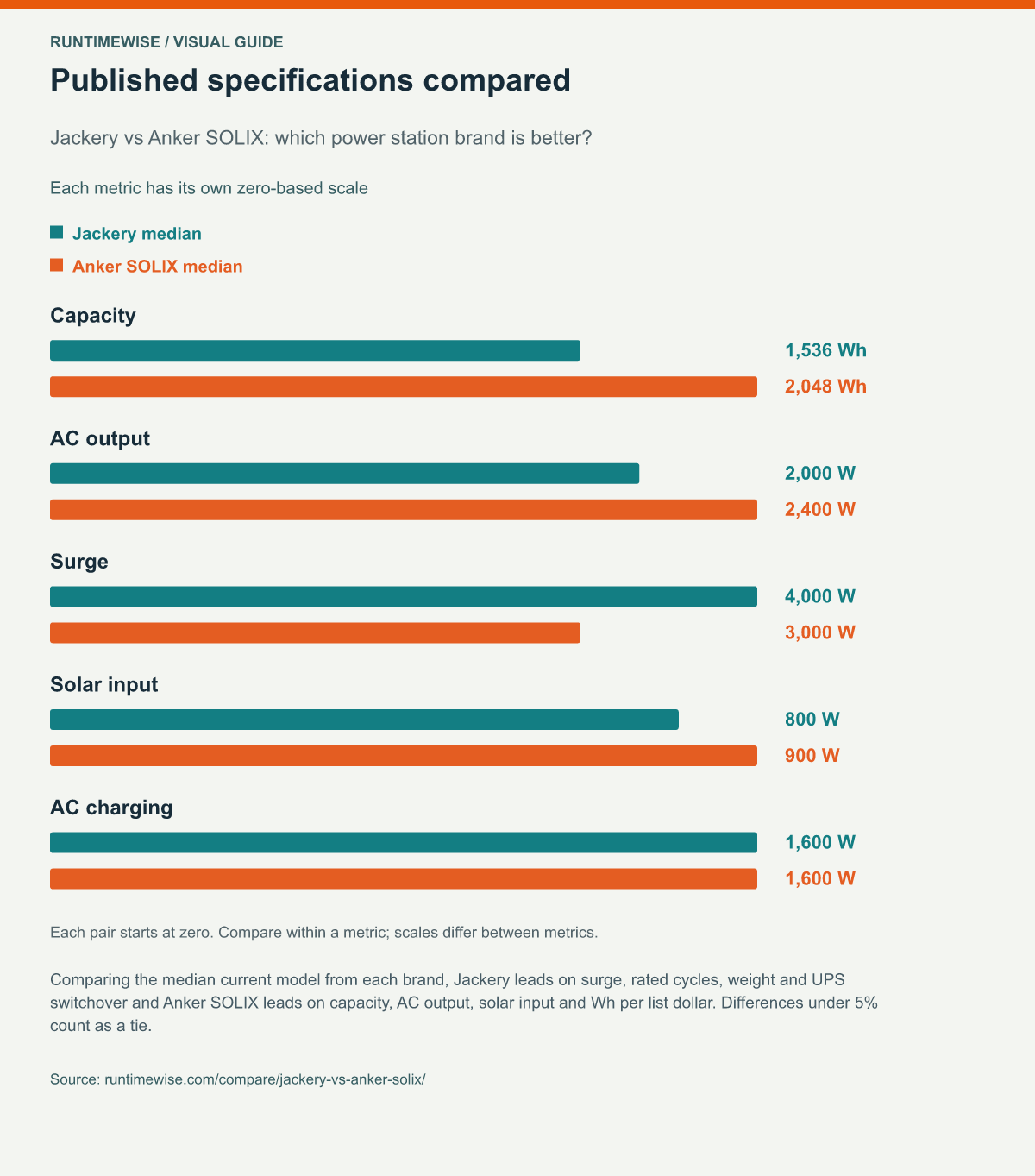
A median is the middle model of each lineup, so one very large or very small model doesn't skew it. Jackery has 15 current models and Anker SOLIX has 9; the all-brand column is the median of all 59 models we track.
| Spec | Jackery median | Anker SOLIX median | All brands | Leads |
|---|---|---|---|---|
| Capacity | 1,536 Wh | 2,048 Wh | 1,264 Wh | Anker SOLIX |
| AC output | 2,000 W | 2,400 W | 2,000 W | Anker SOLIX |
| Surge | 4,000 W | 3,000 W | 3,600 W | Jackery |
| Solar input | 800 W | 900 W | 800 W | Anker SOLIX |
| AC charging | 1,600 W | 1,600 W | 1,470 W | About the same |
| Rated cycles | 4,000 | 3,000 | 4,000 | Jackery |
| Weight | 32 lb | 41.7 lb | 35.3 lb | Jackery |
| UPS switchover | 10 ms | 15 ms | 10 ms | Jackery |
| Wh per list $ | 1.62 | 1.71 | 1.45 | Anker SOLIX |
Which brand has a model in the size you need?
Jackery covers 5 of 5 size bands and Anker SOLIX covers 4. Only Jackery sells a model in the 500–999 Wh band.
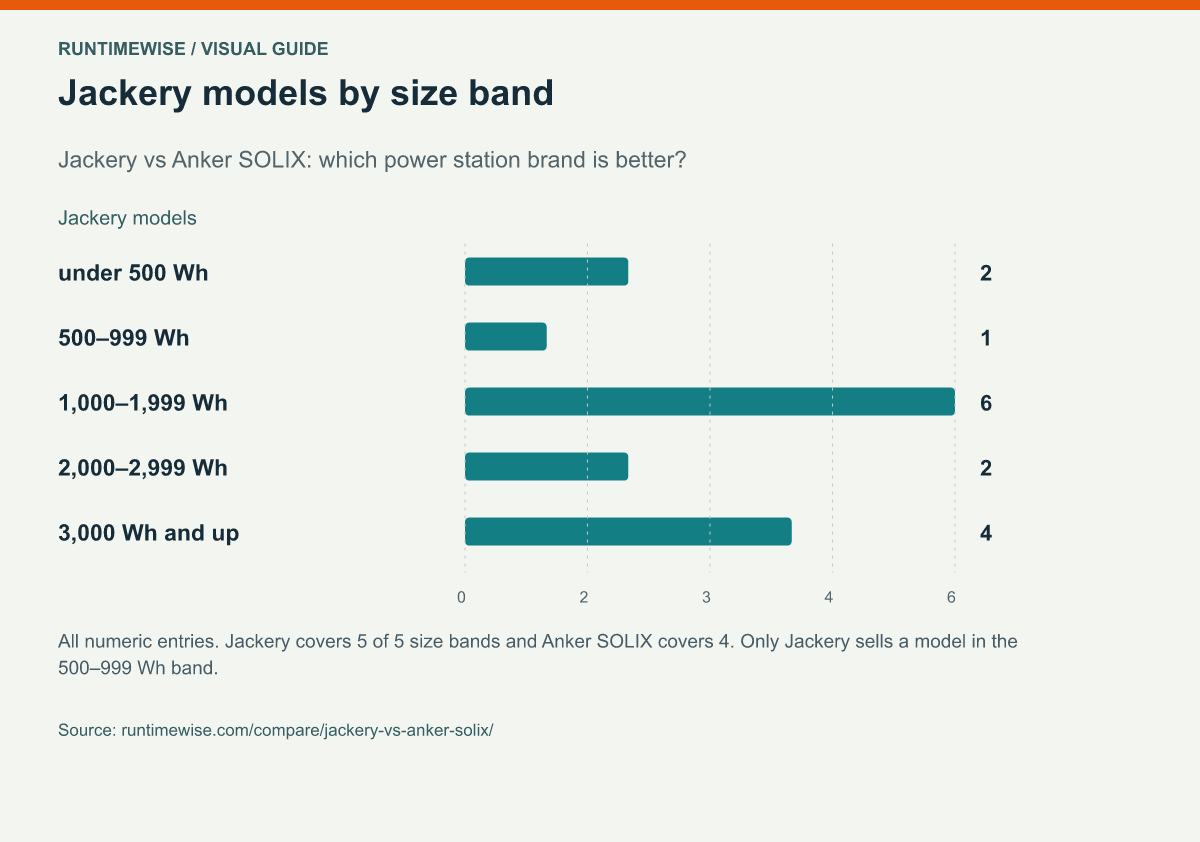
Pick the size band from what you need to run first, then compare the two brands inside it. The cheapest column is the lowest official list price in that band.
| Size band | Jackery models | Anker SOLIX models | Cheapest Jackery | Cheapest Anker SOLIX |
|---|---|---|---|---|
| under 500 Wh | 2 | 1 | Jackery Explorer 240 v2 ($249) | Anker SOLIX C300 ($329.99) |
| 500–999 Wh | 1 | 0 | Jackery Explorer 500 v2 ($399) | — |
| 1,000–1,999 Wh | 6 | 2 | Jackery Explorer 1000 v2 ($559) | Anker SOLIX C1000 Gen 2 ($599.99) |
| 2,000–2,999 Wh | 2 | 3 | Jackery Explorer 2000 v2 ($999) | Anker SOLIX S2000 ($999.99) |
| 3,000 Wh and up | 4 | 3 | Jackery HomePower 3000 ($1,499) | Anker SOLIX F3000 ($1,699.99) |
Size for size, which Jackery or Anker SOLIX model comes out ahead?
We paired each Jackery model with the Anker SOLIX model closest in capacity (within 30%), giving 12 pairs. Across them, Jackery leads on 28 spec comparisons and Anker SOLIX on 21, counting capacity, AC output, surge, solar input, weight and watt-hours per list dollar.
A spec only counts when the gap is more than 5%. Open a model to see every figure and its source.
| Jackery model | Closest Anker SOLIX | Wh | Jackery leads on | Anker SOLIX leads on |
|---|---|---|---|---|
| Jackery Explorer 240 v2 | Anker SOLIX C300 | 256 vs 288 | weight and Wh per list dollar | capacity |
| Jackery Explorer 300 | Anker SOLIX C300 | 294 vs 288 | weight and Wh per list dollar | surge |
| Jackery HomePower 1000 v2 | Anker SOLIX C1000 Gen 2 | 1,024 vs 1,024 | weight | AC output and Wh per list dollar |
| Jackery HomePower 1000 Plus v2 | Anker SOLIX C1000 Gen 2 | 1,024 vs 1,024 | surge | AC output, solar input and Wh per list dollar |
| Jackery Explorer 1000 v2 | Anker SOLIX C1000 | 1,070 vs 1,056 | surge, weight and Wh per list dollar | AC output and solar input |
| Jackery Explorer 1000 Plus | Anker SOLIX C1000 | 1,264 vs 1,056 | capacity, AC output, surge and solar input | weight |
| Jackery Explorer 2000 v2 | Anker SOLIX C2000 Gen 2 | 2,042 vs 2,048 | surge, weight and Wh per list dollar | AC output and solar input |
| Jackery HomePower 2000 Plus v2 | Anker SOLIX C2000 Gen 2 | 2,048 vs 2,048 | surge and Wh per list dollar | — |
| Jackery HomePower 3000 | Anker SOLIX F3000 | 3,072 vs 3,072 | weight and Wh per list dollar | solar input |
| Jackery HomePower 3600 Plus | Anker SOLIX F3800 Plus | 3,584 vs 3,840 | weight and Wh per list dollar | capacity, AC output, surge and solar input |
| Jackery HomePower 3600 Pro Max | Anker SOLIX F3800 Plus | 3,584 vs 3,840 | weight and Wh per list dollar | capacity, AC output, surge and solar input |
| Jackery Explorer 5000 Plus | Anker SOLIX F3800 Plus | 5,040 vs 3,840 | capacity, AC output, surge and solar input | — |
How long do matched Jackery and Anker SOLIX models run the same appliances?
Runtime follows battery capacity, so the model with more watt-hours in each pair runs longer; the inverter decides whether a motor load such as a fridge can start at all.
Calculated from a full charge as capacity × 85% ÷ average draw, with the fridge on about a third of the time. These are calculations from published specs, not test results.
| Pair (first vs second) | Fridge | CPAP | Router |
|---|---|---|---|
| Jackery Explorer 240 v2 vs Anker SOLIX C300 | Can’t run vs Can’t run | 3.9 h vs 4.4 h | 11 h vs 12 h |
| Jackery Explorer 300 vs Anker SOLIX C300 | Can’t run vs Can’t run | 4.5 h vs 4.4 h | 12 h vs 12 h |
| Jackery HomePower 1000 v2 vs Anker SOLIX C1000 Gen 2 | 13 h vs 13 h | 16 h vs 16 h | 44 h vs 44 h |
| Jackery HomePower 1000 Plus v2 vs Anker SOLIX C1000 Gen 2 | 13 h vs 13 h | 16 h vs 16 h | 44 h vs 44 h |
| Jackery Explorer 1000 v2 vs Anker SOLIX C1000 | 14 h vs 14 h | 16 h vs 16 h | 45 h vs 45 h |
| Jackery Explorer 1000 Plus vs Anker SOLIX C1000 | 16 h vs 14 h | 19 h vs 16 h | 2.2 days vs 45 h |
| Jackery Explorer 2000 v2 vs Anker SOLIX C2000 Gen 2 | 26 h vs 26 h | 31 h vs 31 h | 3.6 days vs 3.6 days |
| Jackery HomePower 2000 Plus v2 vs Anker SOLIX C2000 Gen 2 | 26 h vs 26 h | 31 h vs 31 h | 3.6 days vs 3.6 days |
| Jackery HomePower 3000 vs Anker SOLIX F3000 | 40 h vs 40 h | 47 h vs 47 h | 5.4 days vs 5.4 days |
| Jackery HomePower 3600 Plus vs Anker SOLIX F3800 Plus | 46 h vs 2.1 days | 2.3 days vs 2.4 days | 6.3 days vs 6.8 days |
| Jackery HomePower 3600 Pro Max vs Anker SOLIX F3800 Plus | 46 h vs 2.1 days | 2.3 days vs 2.4 days | 6.3 days vs 6.8 days |
| Jackery Explorer 5000 Plus vs Anker SOLIX F3800 Plus | 2.7 days vs 2.1 days | 3.2 days vs 2.4 days | 8.9 days vs 6.8 days |
Which brand has a model for each use?
Jackery has at least one qualifying model for 14 of our 14 use-case lists and Anker SOLIX for 13. Each cell shows how many models qualify and the lowest-priced one.
Every list filters on published requirements such as surge for a fridge or solar input for off-grid charging; the requirement is printed on each list page.
Which brand's best model leads on charging, lifespan and weight?
14 of 15 Jackery models and 9 of 9 Anker SOLIX models use LiFePO4 cells, the chemistry with the longer rated cycle life. The table names each brand's top model on the specs that decide everyday use.
Wall charge time is 0–100% on AC as the maker states it; solar input is the maximum the station accepts, which caps solar charging speed whatever the panel size.
| Spec | Jackery | Anker SOLIX |
|---|---|---|
| Fastest wall charge | Jackery HomePower 1000 v2 (50 min) | Anker SOLIX C1000 Gen 2 (49 min) |
| Highest solar input | Jackery Explorer 5000 Plus (4,000 W) | Anker SOLIX F3800 Plus (3,200 W) |
| Most rated cycles | Jackery HomePower 1000 v2 (6,000 cycles) | Anker SOLIX S2000 (6,000 cycles) |
| Fastest UPS switchover | Jackery Explorer 5000 Plus (0 ms) | Anker SOLIX C300 (10 ms) |
| Lightest | Jackery Explorer 300 (7.1 lb) | Anker SOLIX C300 (9.1 lb) |
| Largest battery | Jackery Explorer 5000 Plus (5,040 Wh) | Anker SOLIX F3800 Plus (3,840 Wh) |
Should you buy Jackery or Anker SOLIX?
Neither brand wins outright on published specs; which is better depends on what you weigh most.
- Pick Jackery if surge, rated cycles, weight and UPS switchover matter most to you; its median model leads there.
- Pick Anker SOLIX if capacity, AC output, solar input and Wh per list dollar matter most; its median model leads there.
- For a 500–999 Wh station, only Jackery of the two has one.
- Otherwise decide model against model: find the size you need in the table above and compare that pair, because the gap between two specific models is often bigger than the gap between brands.
What do Jackery and Anker SOLIX leave unpublished?
Jackery: rated cycles (1 of 15) and UPS switchover (2 of 15). Anker SOLIX: UPS switchover (1 of 9) and AC charge time (5 of 9).
We never estimate a missing figure. A model with an unpublished spec drops out of comparisons and lists that need it, which can make a brand look weaker than its hardware is.
Related
How this page was made. Specs come from each manufacturer's official US spec page or manual, checked on the date shown; specs a manufacturer doesn't publish are marked "Not published". Runtimes are calculated (capacity × 85% inverter efficiency ÷ appliance draw), not measured. We haven't hands-on tested these units. Method and sources · Affiliate disclosure