Portable power station price per watt-hour
Across 58 current models, a watt-hour of portable power station capacity lists at a median of $0.69. Units under 1,000 Wh cost the most per watt-hour ($0.98), and 2,000–3,999 Wh units the least ($0.59). Below, every model is ranked, with medians by size and brand.
Key findings
At manufacturers' list prices, a watt-hour of portable power station capacity costs a median of $0.69 across 58 current models.
Small units cost the most per watt-hour: the median is $0.98/Wh under 1,000 Wh, against $0.59/Wh for 2,000–3,999 Wh units.
The lowest list price per watt-hour belongs to the BLUETTI Elite 400 ($0.36/Wh) and the highest to the Goal Zero Yeti 1000 ($1.20/Wh).
Median list price per watt-hour by brand runs from $0.46 (BLUETTI) to $1.02 (Goal Zero).
On Amazon, the median current price works out to $0.55/Wh for 45 of these models, 17% below their list price, as of 2026-10-22 04:15:10 UTC.
How much does a watt-hour of battery cost?
The median current portable power station lists at $0.69 per watt-hour of capacity. At that rate, a 1,000 Wh unit lists for about $692 and a 2,000 Wh unit for about $1,383. Sales often cut these prices sharply, so treat list price as the ceiling. Price per watt-hour is a way to compare models of different sizes on equal terms.
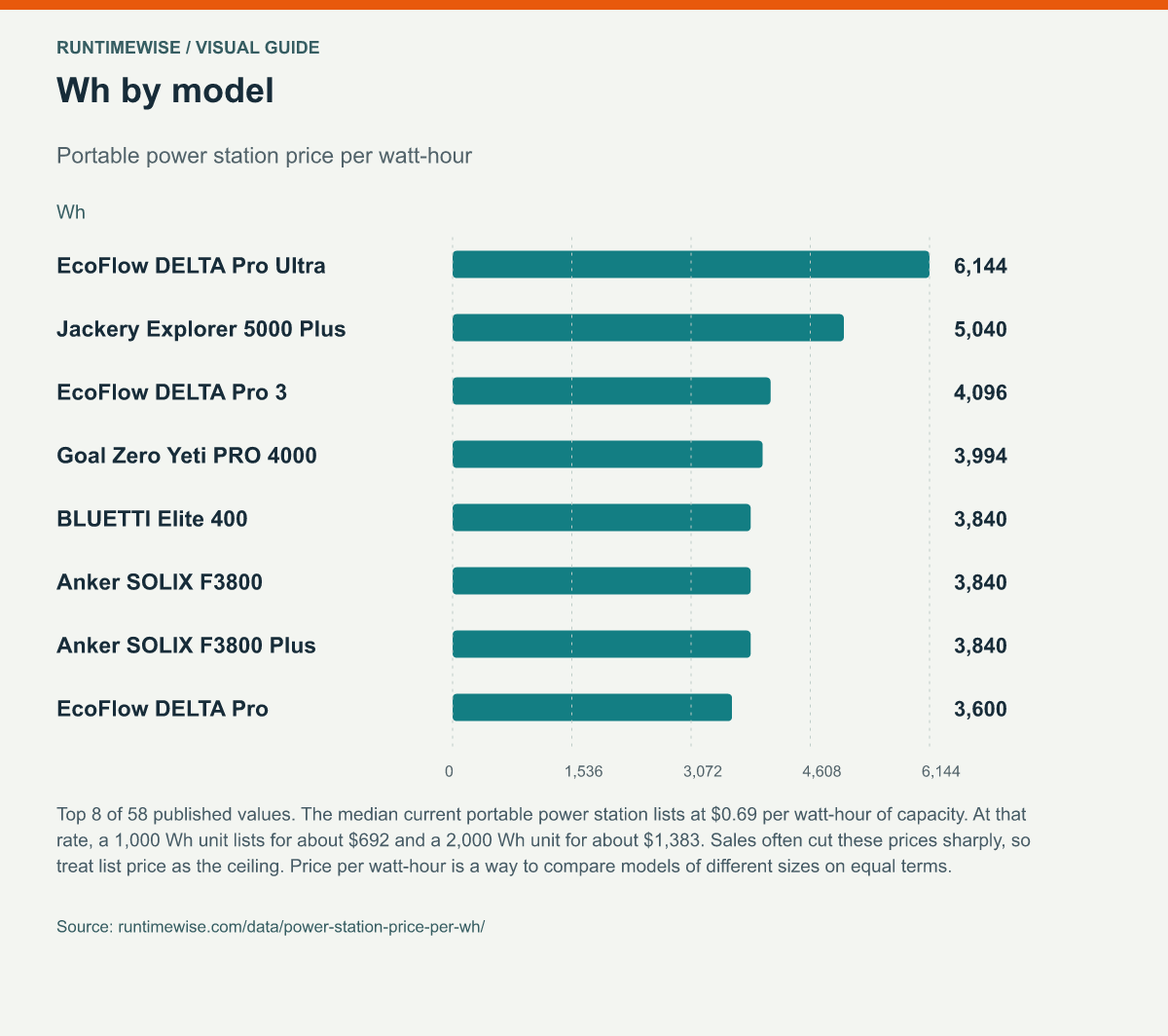
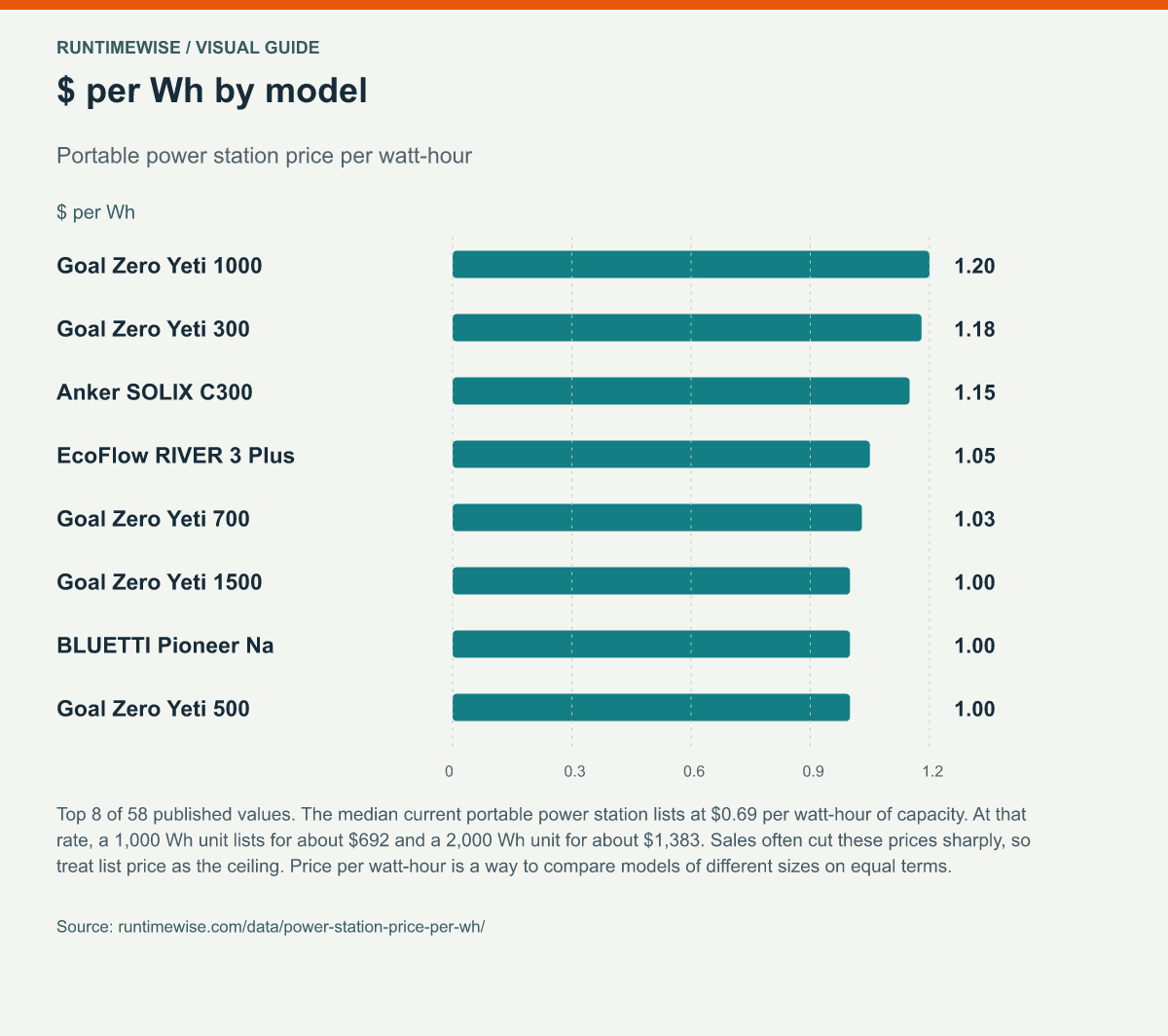
Amazon prices as of 2026-10-22 04:15:10 UTC. Product prices and availability are accurate as of the date/time indicated and are subject to change. Any price and availability information displayed on Amazon.com at the time of purchase will apply to the purchase of the product.
Sorted from lowest to highest list price per Wh. $ per AC watt is list price ÷ continuous output; Wh per $ is the inverse of $ per Wh.
Are bigger power stations cheaper per watt-hour?
Up to a point. The inverter, case, screen and ports cost about the same whatever the battery size, so they make up a bigger share of a small unit's price. The median list price per watt-hour is $0.98 under 1,000 Wh and falls to $0.59 for 2,000–3,999 Wh units. The 3 systems at 4,000 Wh or more cost more again ($0.81), but they also deliver far more output, including 240 V on some models. Add-on batteries for expandable systems have no inverter, so they usually cost less per watt-hour than the main unit.
Which brand is cheapest per watt-hour?
BLUETTI has the lowest median list price per watt-hour across its current lineup, and Goal Zero the highest. Brand medians partly reflect lineup mix, so compare models of similar size. Also check what you need besides capacity: surge output for motors, solar input for off-grid use, and UPS switchover time for computers.
What else decides value besides price per watt-hour?
Price per watt-hour ignores how long the battery lasts. Dividing list price by capacity × rated cycles gives a lifetime cost per stored kilowatt-hour. At the median list price and the median rating of 4,000 cycles, that is about $0.17 per kWh over the battery's rated life, before inverter losses. Add the cost of the electricity to charge it (see cost to charge by state), and you can compare a battery like for like with a fuel generator or grid power.
Can you download and reuse this data?
Yes. The main table is available as a CSV file (58 rows), and every chart on this page opens as a full-size image when you select it. Our compilation, calculations and charts are licensed CC BY 4.0: reuse them in articles, reports, slides or lessons, as long as you credit RuntimeWise and link to this page. The underlying data belongs to the sources listed below, so please credit them too.
How should you cite this page?
Copy one of these. A link to this page is the only credit we ask for.
Citation
RuntimeWise (2026). Portable Power Station Price per Wh (Cost per Watt-Hour). Retrieved October 22, 2026, from https://www.runtimewise.com/data/power-station-price-per-wh/HTML link
<a href="https://www.runtimewise.com/data/power-station-price-per-wh/">Portable Power Station Price per Wh (Cost per Watt-Hour)</a> (RuntimeWise)How was this data compiled?
List prices are each manufacturer's regular U.S. price on its own online store, checked on the date given in the CSV. They are not sale or coupon prices. Capacities and continuous outputs are the published specs from our power station database. Amazon prices come from Amazon's product data, refreshed twice a day, and are shown only when less than 24 hours old.
- $ per Wh = list price ÷ rated capacity. We use medians because a few very large or very small units would skew an average.
- Capacity bands: under 1,000 Wh; 1,000–1,999 Wh; 2,000–3,999 Wh; 4,000 Wh or more.
- Limits: brands set list prices and can inflate them to make sales look bigger, so the price you actually pay is usually lower. Bundles with panels or extra batteries are left out.
Sources
- Manufacturer U.S. online stores (one link per model in the CSV)
- RuntimeWise portable power station database